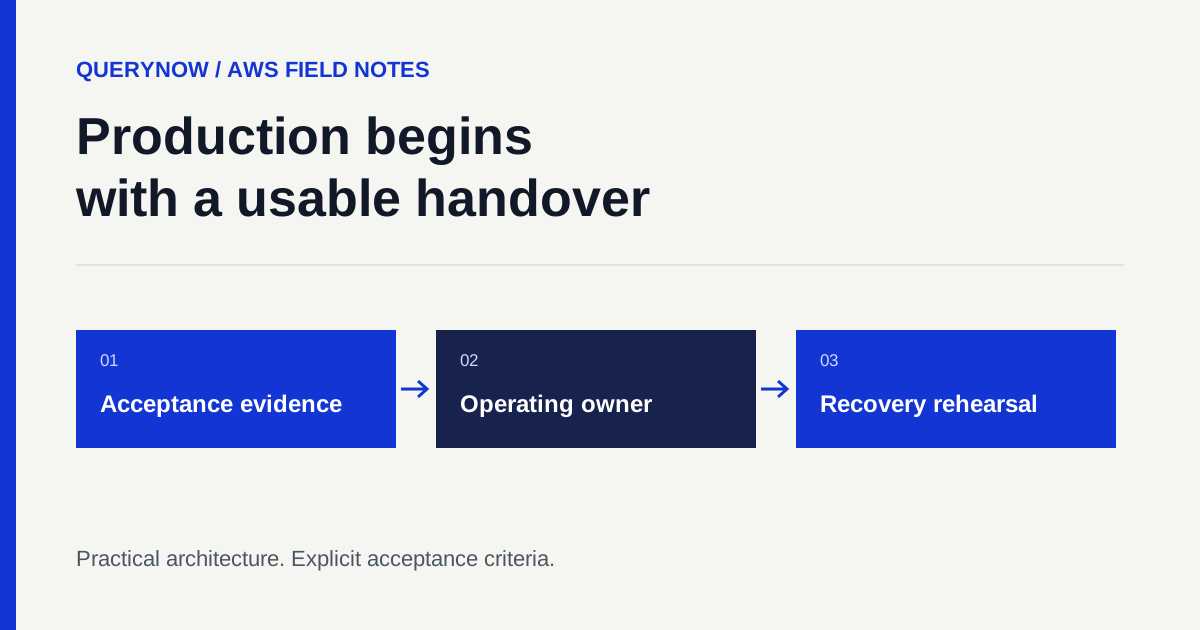
Amazon Bedrock handover checklist: acceptance tests and operating ownership for production workflows
Proofs on Amazon Bedrock often look good in a console. Production is where they fail. The gap is not model quality. It is handover discipline.
Boards now expect ROI in quarters. EU AI Act enforcement hits in August 2026. The payoff for getting this right is faster time to value with audit-ready evidence and lower risk.
Why this matters for enterprises
Most AI misses are operating model problems, not technology. Recent 2026 reports show 88 percent of large organizations use AI in at least one function, while fewer than 10 percent have fully scaled any one function. Only about 6 percent report more than 5 percent EBIT from AI. The pattern is clear. Build is easy. Run is hard.
Shadow AI increases risk. Data readiness and change management slow rollouts. For regulated industries, this becomes a compliance exposure across HIPAA, GxP, SOX, PCI DSS, GDPR, and the EU AI Act. Your Bedrock handover must prove control over data boundaries, identity, approvals, tracing, and rollback. Treat it as an operating-model transition, not a code deploy.
If you are multi-cloud, keep identity, policy, logging, and evaluation consistent across AWS, Azure, and Google Cloud. Your reference architectures can be reusable. Your acceptance evidence must be environment specific by account, region, and data residency.
A practical handover plan for Amazon Bedrock
1. Define the workload boundary
- Document the exact Bedrock workflow and the business task it completes. State the inputs, retrieved content, tool actions, outputs, and what is in scope for production ownership.
- List upstream and downstream systems. Include S3 locations, Amazon Bedrock Knowledge Bases that will be used for retrieval, and any orchestrations using Amazon Bedrock AgentCore, AWS Lambda, or AWS Step Functions.
- Identify the instruction templates, guardrails, and evaluation datasets that will be versioned and governed. Avoid vague references. Name the artifacts and owners.
2. Write acceptance tests around business outcomes
- Answer quality. Define task-specific scoring and thresholds. For example, product spec accuracy at 95 percent or better on a held-out set.
- Tool and function correctness. Validate external actions and internal tool calls end to end. Confirm data writes, API payloads, and state transitions in Step Functions.
- Latency. Set 95th percentile targets for the full workflow. Include retrieval, tool calls, and external APIs. Example target is p95 under 3 seconds for a support deflection task.
- Resilience and retry behavior. Confirm backoff, idempotency keys, and duplicate suppression in downstream systems.
- Human-review rate. Define when a human must approve or review. Track escalation and approval times by queue.
- Cost per completed task. Measure total cost including Bedrock invocations, retrieval, compute, and egress. Tag resources so you can attribute costs per workflow.
3. Test failure modes on purpose
- Difficult and ambiguous inputs. Include noisy text, conflicting instructions, and incomplete context.
- Malformed inputs and unsafe content. Confirm guardrails and content filters are active and logged.
- Empty retrieval results. Validate behavior when Knowledge Bases return no matches. Require a safe fallback or human escalation.
- Timeouts and quotas. Simulate Bedrock throttling, Lambda timeouts, and Step Functions task failures.
- Downstream API failures. Prove rollback or compensation steps when an external system rejects a write.
4. Name operating ownership before go-live
- Release owner. Accountable for delivery, change control, and versioning of instruction templates, guardrails, and integrations.
- Operations owner. Accountable for monitoring, incidents, and rollback. Maintains runbooks, on-call coverage, and comms.
- RACI. Publish who approves changes, who can pause the workflow, and who can authorize consequential tool actions.
5. Verify observability is operational, not theoretical
- Traces. Use Amazon Bedrock Flows tracing for step-level visibility during tests and capture trace artifacts as handover evidence.
- Logs. Ensure CloudWatch logs are structured, retained per policy, and queryable. Route critical logs to S3 for long-term retention and Athena queries. Enable CloudTrail for access and configuration events.
- Metrics and alerts. Track success rate, escalation rate, p95 latency, error types, cost per task, and approval wait times. Define alarms and on-call responses.
- Post-incident review. Confirm you can reconstruct a workflow instance end to end with timestamps, inputs, retrieved sources, tool calls, and outputs.
6. Treat data boundaries as a compliance control
- Input policy. Define what data can enter the workflow. Document PHI or PII handling if applicable and ensure encryption in transit and at rest with KMS.
- Storage and retention. Identify where evaluation data, traces, and outputs are stored and for how long. Set retention aligned to GDPR, HIPAA, or internal policy.
- Access to artifacts. Restrict who can view logs, retrieved content, and outputs. Log all access.
7. Validate security and access end to end
- IAM roles and permissions. Do not assume permissions propagate across Bedrock, Knowledge Bases, S3, or external systems. Validate least privilege for every role.
- Lake Formation vs retrieval. Lake Formation table permissions do not automatically apply to downstream vector indexes. Enforce end-user authorization at retrieval time.
- Approval gates. Require human approval for consequential actions like creating customer communications or initiating financial changes. Enforce gates in Step Functions or your orchestration layer.
8. Build explicit rollback criteria
- Performance thresholds. For example, success rate below 98 percent for 15 minutes triggers rollback to the prior version.
- Safety thresholds. Unsupported claim rate or unsafe content flag above 0.5 percent triggers pause and review.
- Cost thresholds. Cost per task exceeding target by 20 percent for a day triggers revert to prior configuration.
- Rollback plan. Define how to switch traffic. Blue green or weighted routing at the orchestration layer. Document the steps and owners.
9. Separate model evaluation from workflow evaluation
- A strong foundation model can fail inside a weak workflow. Evaluate retrieval, instruction templates, tool calls, and chaining logic independently and together.
- Use reference architectures for repeatability. Treat acceptance evidence as environment specific and attach it to the release.
10. Put change management around guardrails and integrations
- Version and review instruction templates, guardrails, knowledge sources, and tool integrations like code. Require approvals and automated tests.
- Use infrastructure as code such as AWS CloudFormation or CDK to make handover reproducible and auditable.
Architecture notes where Bedrock fits
Keep the focus on the workflow. A typical reference design routes user input to an Amazon Bedrock Flow or AgentCore orchestrator, retrieves context via Amazon Bedrock Knowledge Bases, executes tools with AWS Lambda, and manages state with AWS Step Functions. S3 stores evaluation datasets, traces, and outputs. CloudWatch and CloudTrail provide logs and audit trails. Lake Formation governs source data access while IAM scopes runtime roles. This is a blueprint. Your acceptance tests and controls must validate your actual account, region, and data.
For retrieval heavy use cases, pair this checklist with intelligent retrieval patterns. See our Enterprise RAG Systems approach for production-grade retrieval evaluation and controls.
Examples you can run this quarter
- Pharma and life sciences. Require source traceability, controlled output formatting, and human review before use in GxP or 21 CFR Part 11 processes. Store trace artifacts and approvals for audit.
- Healthcare. Validate PHI handling, audit logs, and escalation paths. Set rollback triggers if unsupported claim rate or retrieval gaps exceed tolerance. Align to HIPAA and internal safety bars.
- Manufacturing. Triage maintenance tickets with noisy inputs. Set p95 latency under downtime thresholds. Require correct asset matching and part numbers before work order creation.
- Retail and consumer. Measure product content by factual accuracy, policy compliance, and tone consistency. Enforce guardrails for promotions and returns. Escalate exceptions to a human queue.
- Financial services. Add approval workflows and output explainability for customer communications and decision support. Align controls with SOX, FFIEC, and PCI DSS where relevant.
What good looks like
- Time to value. Two weeks from scoped workflow to production cutover with acceptance evidence attached to the release.
- Reliability. Success rate above 99 percent in steady state. p95 latency under the business threshold. Fallback or escalation under 1 second when needed.
- Safety. Unsupported claim rate below 0.2 percent in production. All consequential actions gated by approvals and logged.
- Cost control. Cost per completed task tracked daily and within 10 percent of target. No surprise egress or compute spikes.
- Operations. MTTR under 30 minutes with trace-driven diagnosis. Incident runbook executed within 5 minutes. Full audit reconstruction available for 100 percent of sampled runs.
- Governance. Versioned instruction templates, guardrails, and integrations with approvals. Access reviews passed. Data retention aligned to policy and GDPR.
How QueryNow helps
QueryNow has built enterprise AI since 2014 with 200 plus production agent deployments and a 100 percent production success rate. We design agentic workflows that meet enterprise controls from day one. We deploy on AWS, Azure, Google Cloud, or hybrid. On AWS, we align your Bedrock architecture to your identity, policy, logging, and data boundaries, then we prove it with acceptance evidence.
We keep it simple. Tell us one workflow you want gone. We scope it with fixed deliverables and acceptance criteria. We build it in your environment in two weeks. You pay 10,000 dollars only after every criterion you signed off on is met. Nothing upfront. One workflow at a time.
Want deeper AWS-specific support for AI and data services including Bedrock, Knowledge Bases, AgentCore, and production observability on CloudWatch and CloudTrail
Ready to ship AI in your organization?
We build one workflow into a working tool in two weeks. You pay $10,000 only after every acceptance criterion you signed off on is met.
One workflow · Two-week build · $10,000, paid on delivery
QueryNow
QueryNow deploys production AI for enterprises on Azure, AWS, or Google Cloud. Founded in 2014, we help pharma, healthcare, manufacturing, and financial services organizations deploy governed AI systems. We build it, you pay when it works.
Learn more about us →