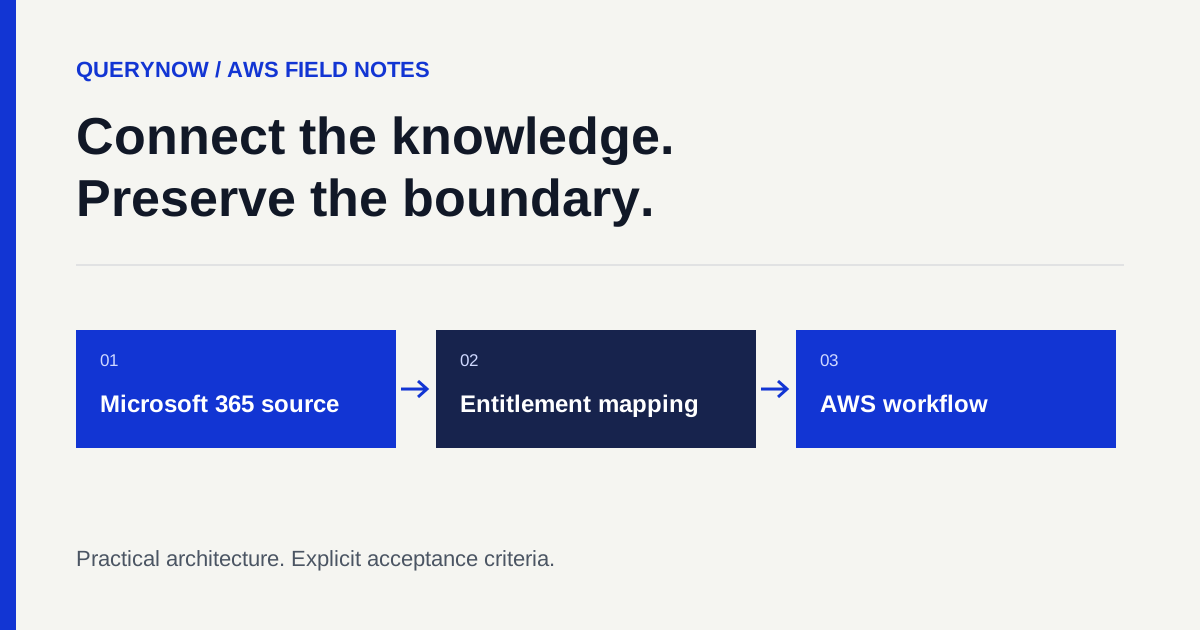
A company can keep its collaboration content in Microsoft 365 and build a workflow on AWS. The difficult part is usually not moving document text. It is preserving who may use that text after it reaches another system.
Start with one approved collection and a documented access model. Treat the connection as a governed integration. The existence of an API or connector does not establish that your end-user permission requirements are satisfied.
Choose the integration boundary
Decide whether the AWS workflow queries the source when needed or uses a prepared copy for retrieval. A live lookup may reduce the amount of copied content, while an indexed collection can suit repeated search. Both approaches need an explicit permission design.
For a reference policy assistant, begin with a library whose ownership and audience are clear. Avoid combining public employee guidance with restricted case records just because both live in the same tenant.
Separate connector access from user access
The integration identity may need permission to read an approved source collection. That permission does not mean every user of the assistant may read every document the connector can reach. Evaluate the user boundary independently.
Record which identity provider authenticates the user and how that identity maps to the source permissions. Resolve access from trusted system data. Do not accept a group name supplied in the question as proof of membership.
Preserve the right metadata
Keep a stable document identifier and the source location needed for citations. Record the version or change marker used during ingestion. Where the retrieval design depends on entitlement metadata, define who owns its accuracy and how it is refreshed.
Some source permissions are more complex than a single department label. A design that flattens every document into one broad group can change its audience. Test the actual access patterns in the chosen collection before selecting a filtering scheme.
Handle deletion and revocation
A deleted source document should not remain available indefinitely through a copied index. Define how the integration detects withdrawal and what the workflow does before the removal completes. The same review should cover a user's lost group membership.
Consider cached answers and conversation history. Restricting a new retrieval request is not enough if a shared cache returns an earlier answer containing the removed material. State the permitted freshness window and test it.
Check the citation experience
The assistant should direct the user to the authoritative document where practical. Verify that the link opens for an authorized user and fails appropriately for someone without access. A citation that leads to a broadly shared copy can undermine the original source boundary.
When source access cannot be established, return a clear limitation. A generated summary should not become an alternative route around a denied source document.
Define the first release narrowly
- One collection has an approved owner and audience.
- Allowed users can retrieve supported answers with usable source links.
- Restricted users cannot retrieve the same content indirectly.
- Document removal and permission revocation meet the agreed freshness target.
- The team can diagnose an identity-mapping failure without granting broader access.
This approach makes an AWS and Microsoft integration a practical workflow decision. It also leaves room to expand after the team can demonstrate that the original access model survives the connection.
Put one workflow into production
QueryNow scopes AWS AI workflows around your existing systems. We agree the deliverables and acceptance criteria before the build. One bounded workflow starts at $10,000, payable only after every agreed criterion is met. We build it in your environment in two weeks. Wider data programs are scoped separately, and AWS usage is separate from the build fee. Tell us the workflow.
Technical references
Ready to ship AI in your organization?
We build one workflow into a working tool in two weeks. You pay $10,000 only after every acceptance criterion you signed off on is met.
One workflow · Two-week build · $10,000, paid on delivery
QueryNow
QueryNow deploys production AI for enterprises on Azure, AWS, or Google Cloud. Founded in 2014, we help pharma, healthcare, manufacturing, and financial services organizations deploy governed AI systems. We build it, you pay when it works.
Learn more about us →