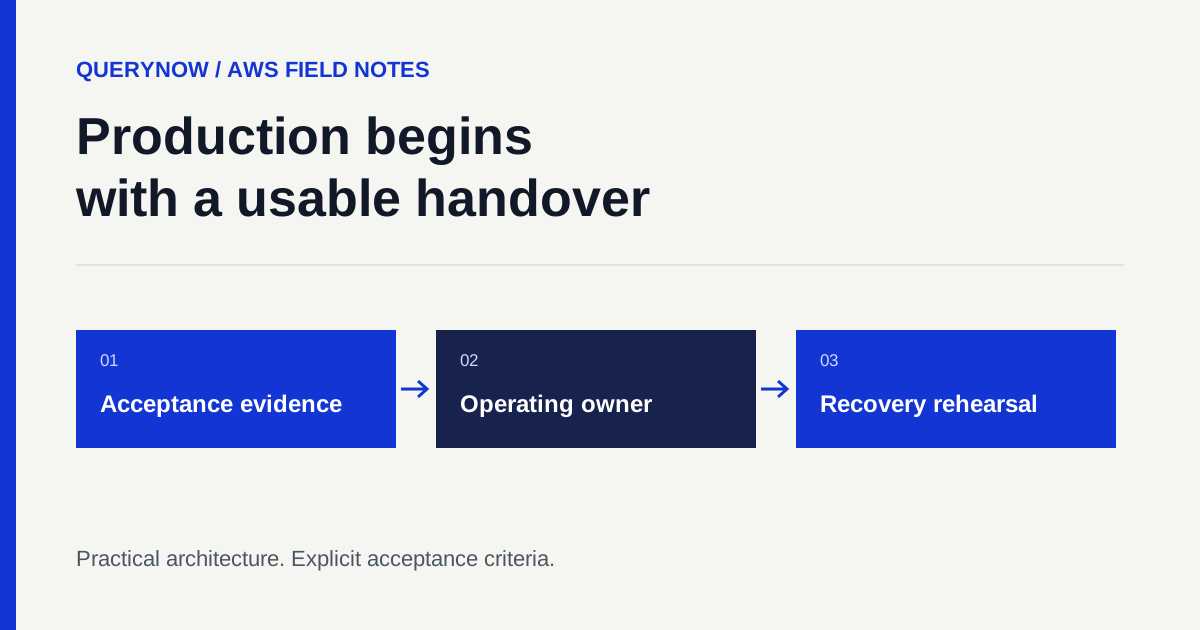
The first successful demonstration shows that a workflow can work. Handover must show that the owning team can keep it working when a source changes or a dependency fails. Those are different deliverables.
For an AWS AI workflow, define handover requirements when the scope is signed. Waiting until the final day to ask who owns access or operating cost creates avoidable gaps between implementation and routine use.
Start with the acceptance evidence
Keep the agreed test cases and the results from the release candidate. Identify the configuration tested, including the model and approved source collection. The evidence should let another engineer repeat the checks without reconstructing the original conversation.
Include failure cases. A knowledge assistant should demonstrate how it handles unavailable evidence and denied access. An action workflow should demonstrate duplicate-request protection and the required approval boundary. A happy-path recording is not a complete acceptance record.
Assign ownership by decision
Name the person or team that can approve a new source. Separately identify who can change application permissions and who reviews operating cost. One team may perform several roles, but each decision should still have an explicit owner.
Document the escalation route when ownership crosses systems. If a source refresh fails because an upstream schema changed, the operator needs to know which team can resolve it. A list of service names cannot provide that answer.
Make configuration recoverable
Provide deployment instructions and the approved configuration values, with secrets referenced through the chosen secret-management process. Do not put live credentials into a handover document. Explain how a credential rotation reaches the running application.
Record which parts of the environment are managed as code and which require an administrative step. A recovery guide should not depend on an undocumented console change remembered by one engineer.
Set the operating budget and signals
Agree the expected workload and the cost assumptions used for the first release. Identify which metrics indicate useful completion and which suggest a problem. Assign an owner to each actionable alert.
Include the quality-review process, not just infrastructure health. A workflow can return successful HTTP responses while its answers deteriorate after a source change. Keep a representative evaluation set that the owner can run before accepting a new configuration.
Rehearse recovery with the owning team
Use a controlled test to simulate an unavailable dependency. Ask the future operator to find the affected execution and follow the runbook. Check whether the documented response restores service without repeating a consequential business action.
For a model or prompt change, demonstrate how to return to the last accepted configuration. A rollback must also account for data or tool changes that may no longer be compatible with the older application.
Close with an explicit release decision
- The business owner signs the acceptance results for the agreed workflow.
- The technical owner can deploy the documented configuration.
- The support owner completes the recovery rehearsal.
- The cost owner understands the workload assumptions and alert thresholds.
- Any remaining limitation has an owner and a defined follow-up decision.
Amazon's operational guidance provides useful prompts for preparing a workload to run. Apply those prompts to the specific task rather than treating a checklist as evidence of readiness. The handover is complete when the owning team can explain what the system does and demonstrate how it recovers.
Put one workflow into production
QueryNow scopes AWS AI workflows around your existing systems. We agree the deliverables and acceptance criteria before the build. One bounded workflow starts at $10,000, payable only after every agreed criterion is met. We build it in your environment in two weeks. Wider data programs are scoped separately, and AWS usage is separate from the build fee. Tell us the workflow.
Technical references
Ready to ship AI in your organization?
We build one workflow into a working tool in two weeks. You pay $10,000 only after every acceptance criterion you signed off on is met.
One workflow · Two-week build · $10,000, paid on delivery
QueryNow
QueryNow deploys production AI for enterprises on Azure, AWS, or Google Cloud. Founded in 2014, we help pharma, healthcare, manufacturing, and financial services organizations deploy governed AI systems. We build it, you pay when it works.
Learn more about us →