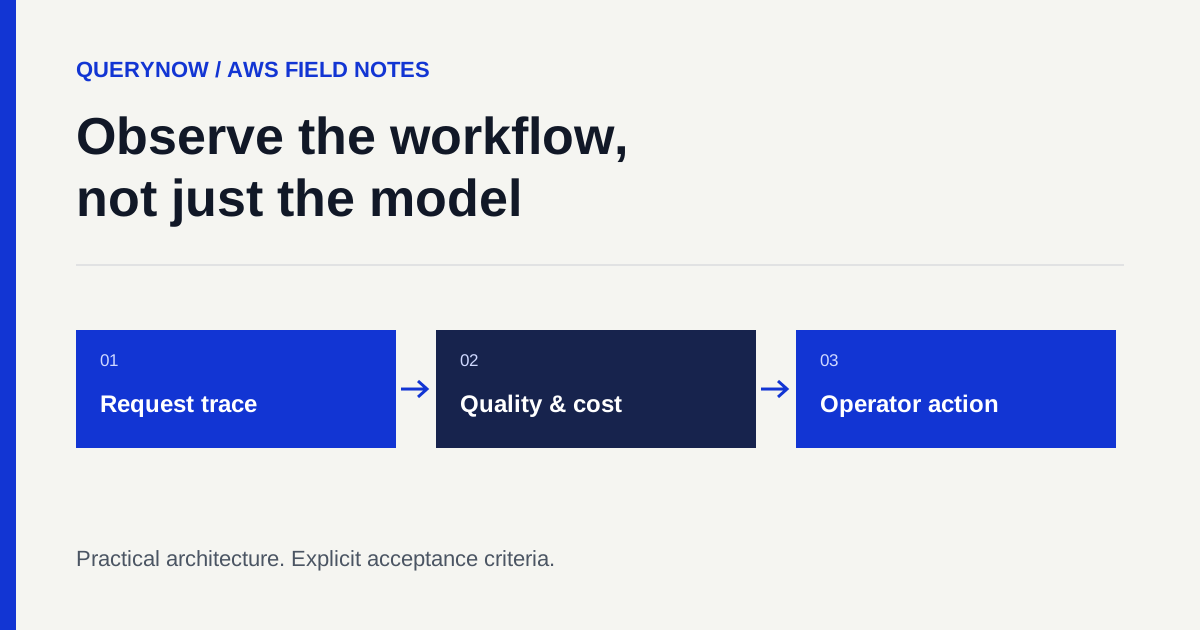
A successful model response does not prove that a business workflow succeeded. The answer may cite an obsolete policy, or the downstream system may reject the action. Monitoring should explain what happened to the user's task.
For a Bedrock application, define the business result first. An operations team needs to distinguish a completed task from an answer that still needs review. That distinction determines what belongs on the dashboard.
Trace one request across the application
Assign an identifier when the request enters the application. Carry it through retrieval and model invocation into any tool call. Record the final business status against that same identifier so the operator does not have to join unrelated logs by timestamp.
Capture the points where a request can stop: denied access, unavailable evidence, model failure, or downstream rejection. These are different outcomes. A single error counter hides which team needs to respond.
Choose logging destinations deliberately
Amazon Bedrock supports model invocation logging to configured destinations such as CloudWatch Logs and Amazon S3. Check the supported invocation paths and configuration for the model and API you use. Application traces are still needed to explain the complete business process.
Before enabling payload logging, decide whether prompts or responses can contain confidential information. Set access and retention requirements for the destination. An observability feature should not create an uncontrolled second store of the same sensitive data.
Monitor useful outcomes
For a knowledge assistant, track whether the user receives a supported answer, an explicit refusal, or an escalation. Review a sample against the approved sources. A low exception rate is not automatically a sign of quality if the assistant is answering questions it should refuse.
For an action workflow, track completion in the system of record. A model saying that it submitted a request is not evidence that the request exists. Use the downstream operation's durable result when calculating completion rates.
Measure cost per completed task
Track model calls and retries per request. Include the retrieval infrastructure and supporting services when reviewing the operating budget. Compare the cost with the number of tasks completed to the agreed quality standard.
Investigate a sudden increase in calls even if the total bill remains within budget. A retry loop or a source-ingestion problem can create unnecessary work before it becomes a large expense. Set an alert with a named owner and a clear first diagnostic step.
Design alerts that lead to action
- A sustained source-ingestion failure sends the operator to the affected collection.
- A rise in denied requests prompts a check of identity or entitlement changes.
- A cost anomaly identifies the workload and model configuration involved.
- A downstream timeout includes the execution identifier needed for reconciliation.
- A quality review failure can stop a configuration rollout.
Keep customer-facing status separate from internal exception detail. Users need to know whether the work completed and what they should do next. Operators need enough context to resolve the problem without exposing credentials or unrelated records.
Rehearse a failure before handover
Disable an approved test dependency and ask the support owner to follow the runbook. Observe whether the alert reaches the right person and whether the documented recovery works. A monitoring dashboard becomes operational only when someone can use it to restore the workflow.
Put one workflow into production
QueryNow scopes AWS AI workflows around your existing systems. We agree the deliverables and acceptance criteria before the build. One bounded workflow starts at $10,000, payable only after every agreed criterion is met. We build it in your environment in two weeks. Wider data programs are scoped separately, and AWS usage is separate from the build fee. Tell us the workflow.
Technical references
Ready to ship AI in your organization?
We build one workflow into a working tool in two weeks. You pay $10,000 only after every acceptance criterion you signed off on is met.
One workflow · Two-week build · $10,000, paid on delivery
QueryNow
QueryNow deploys production AI for enterprises on Azure, AWS, or Google Cloud. Founded in 2014, we help pharma, healthcare, manufacturing, and financial services organizations deploy governed AI systems. We build it, you pay when it works.
Learn more about us →