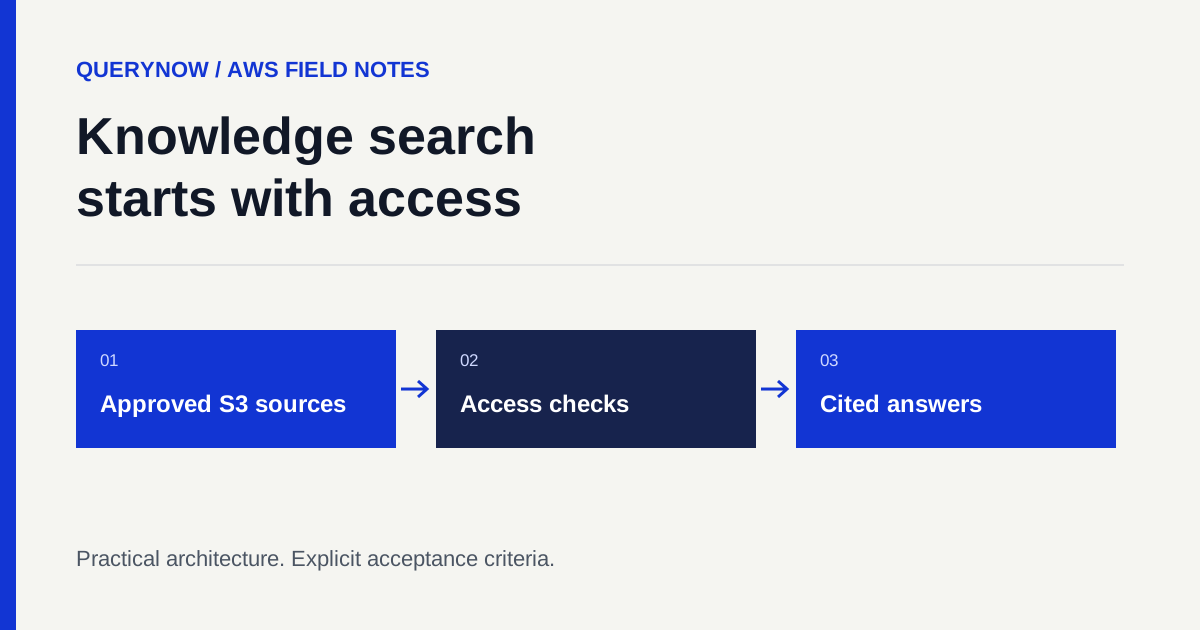
A policy assistant can find the right paragraph and still give the wrong person access to it. Start an AWS knowledge-search project by defining what each user may retrieve. The model choice comes after that decision.
Consider a reference workflow for an operations team. Employees ask questions about approved procedures, while managers can also access restricted guidance. This is a proposed architecture, not a claim about a named client deployment.
Define a small, owned source collection
Choose one document family with an accountable business owner. For example, begin with the approved procedures for one operational unit. Record which repository is authoritative and who can withdraw an obsolete document. A shared folder full of drafts is not an approved knowledge collection.
Amazon Bedrock Knowledge Bases can ingest documents from Amazon S3. Keep a stable source identifier and meaningful version information alongside each document. Decide how corrections reach the search index, including what happens between a source change and the next successful ingestion.
Keep authorization outside the conversation
Authenticate the person before accepting a query. Resolve their permitted source scope on the server. The application should construct any retrieval filters from trusted identity and entitlement data. A user-supplied department name is not evidence that the user belongs to that department.
Metadata filters can narrow retrieval, but a filter mechanism is not a complete authorization system. A broad service role may still have access to more documents than the end user. Test the complete request path and make sure an alternate API call cannot bypass the application check.
Return evidence the reader can inspect
A useful answer names the procedure and points to the supporting passage. Check that the cited source actually supports the answer, rather than simply mentioning the same subject. Source links should lead to a location the reader is authorized to open.
Define behavior for missing evidence. The assistant should say that the approved collection does not answer the question and identify the route for help. It should not fill the gap with a plausible procedure assembled from general model knowledge.
Test the awkward cases first
- A frontline user asks directly for a restricted management procedure.
- The same user asks an indirect question that would reveal the restricted information.
- A document is withdrawn after it has already been indexed.
- Two approved documents contain conflicting instructions.
- The source is temporarily unavailable when the answer is requested.
Run these cases through the same application path that real users will use. Testing the retrieval console alone cannot establish that your login flow, server-side filters, and citation links all enforce the same boundary.
Write acceptance criteria before launch
Agree which questions must be answered and which must be refused. Name the expected source for each answerable question. Set a measurable ingestion-freshness target with the document owner, plus a response-time budget for the complete workflow.
The handover should explain how a new source is approved and how a withdrawn source is removed. Your operations team needs a repeatable process for those changes. A good first release earns trust by answering a narrow set of questions reliably.
Put one workflow into production
QueryNow scopes AWS AI workflows around your existing systems. We agree the deliverables and acceptance criteria before the build. One bounded workflow starts at $10,000, payable only after every agreed criterion is met. We build it in your environment in two weeks. Wider data programs are scoped separately, and AWS usage is separate from the build fee. Tell us the workflow.
Technical references
Ready to ship AI in your organization?
We build one workflow into a working tool in two weeks. You pay $10,000 only after every acceptance criterion you signed off on is met.
One workflow · Two-week build · $10,000, paid on delivery
QueryNow
QueryNow deploys production AI for enterprises on Azure, AWS, or Google Cloud. Founded in 2014, we help pharma, healthcare, manufacturing, and financial services organizations deploy governed AI systems. We build it, you pay when it works.
Learn more about us →