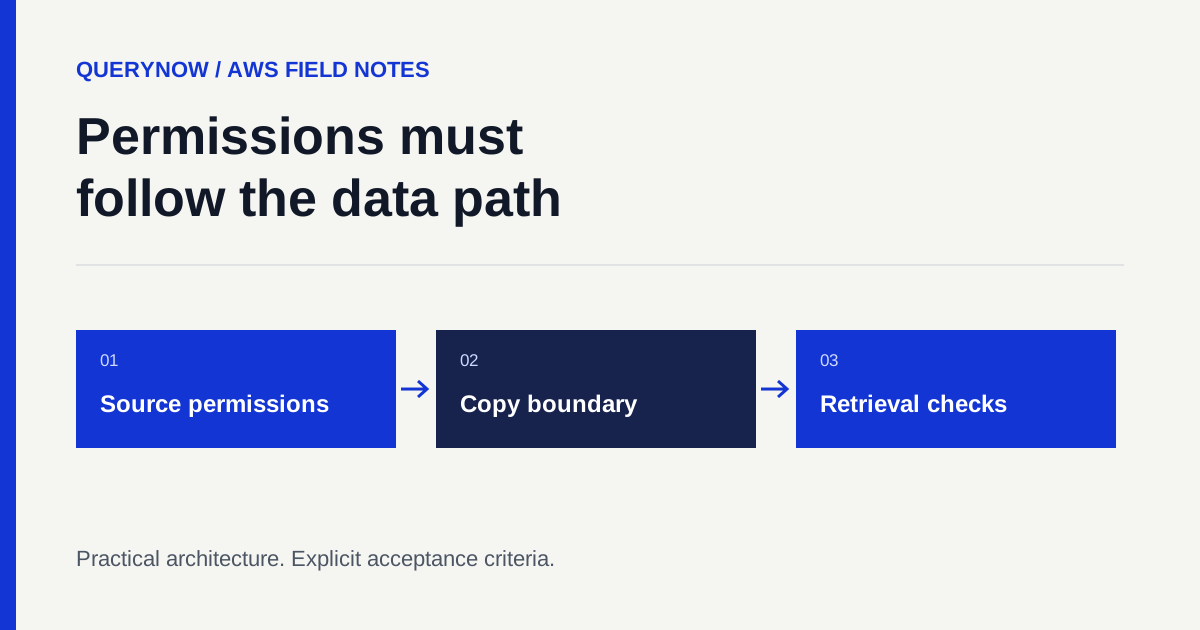
A table can have well-defined permissions while an AI assistant exposes information copied from it. The permission boundary changes when data moves into an export or a retrieval index. A design review must follow that movement.
AWS Lake Formation and Amazon Athena support governed access for documented data paths. That does not establish end-user authorization for every downstream application. Treat the AI retrieval layer as a separate boundary that needs explicit tests.
Draw the path taken by one sensitive field
Start at the authoritative table. Follow the field through each query, export, transformation, and index. At every step, record the executing identity and the rule that permits access. Include any cache that might return an earlier result.
For a reference finance assistant, consider a restricted supplier bank detail. A service role may be allowed to process it, while most employees are not allowed to see it. If the field enters a broadly accessible index, the original table restriction is no longer enough.
Verify the supported access path
Check how the chosen query engine and table format interact with Lake Formation. Support and limitations belong in the design review, not in a last-minute assumption. Record the exact configuration used to establish the intended boundary.
Also inspect direct access to underlying storage. A policy review that covers only the query interface can miss another route to the same data. Test with a representative restricted principal rather than relying on an administrator's successful query.
Decide what may enter the index
One approach is to exclude restricted fields before indexing. Another is to maintain isolated collections for access groups where that fits the operating model. If the application uses retrieval filters, derive them from trusted entitlements on the server.
Each option has a cost. Separate collections can complicate updates. Fine-grained filtering needs reliable entitlement data and complete enforcement. Choose the approach your team can verify and maintain as employees change roles.
Test revocation and cached answers
Removing access is often harder than granting it. Define how a revoked permission reaches every copy that the workflow can use. The design should state whether the application blocks access immediately or within a documented freshness window.
Review conversation history and response caches as well as the retrieval index. A user who loses access to a document should not obtain the same restricted content from a shared cache. The cache key and retention policy are part of the authorization design.
Use negative tests as release evidence
- A user can query an allowed business field but cannot retrieve the restricted field.
- A question phrased indirectly does not reveal the restricted value.
- A revoked entitlement stops access through the documented application path.
- A service-role credential cannot be used from the user-facing client.
- An old conversation cannot expose a source that the user is no longer allowed to read.
Record which layer rejects each request. A model saying it cannot help is weaker evidence than an authorization check preventing the restricted retrieval. The release report should make that distinction visible to the system owner.
This work is also useful outside AI. Following one field through every copy gives the team a concrete map of where policy becomes an enforceable control and where another control is required.
Put one workflow into production
QueryNow scopes AWS AI workflows around your existing systems. We agree the deliverables and acceptance criteria before the build. One bounded workflow starts at $10,000, payable only after every agreed criterion is met. We build it in your environment in two weeks. Wider data programs are scoped separately, and AWS usage is separate from the build fee. Tell us the workflow.
Technical references
Ready to ship AI in your organization?
We build one workflow into a working tool in two weeks. You pay $10,000 only after every acceptance criterion you signed off on is met.
One workflow · Two-week build · $10,000, paid on delivery
QueryNow
QueryNow deploys production AI for enterprises on Azure, AWS, or Google Cloud. Founded in 2014, we help pharma, healthcare, manufacturing, and financial services organizations deploy governed AI systems. We build it, you pay when it works.
Learn more about us →