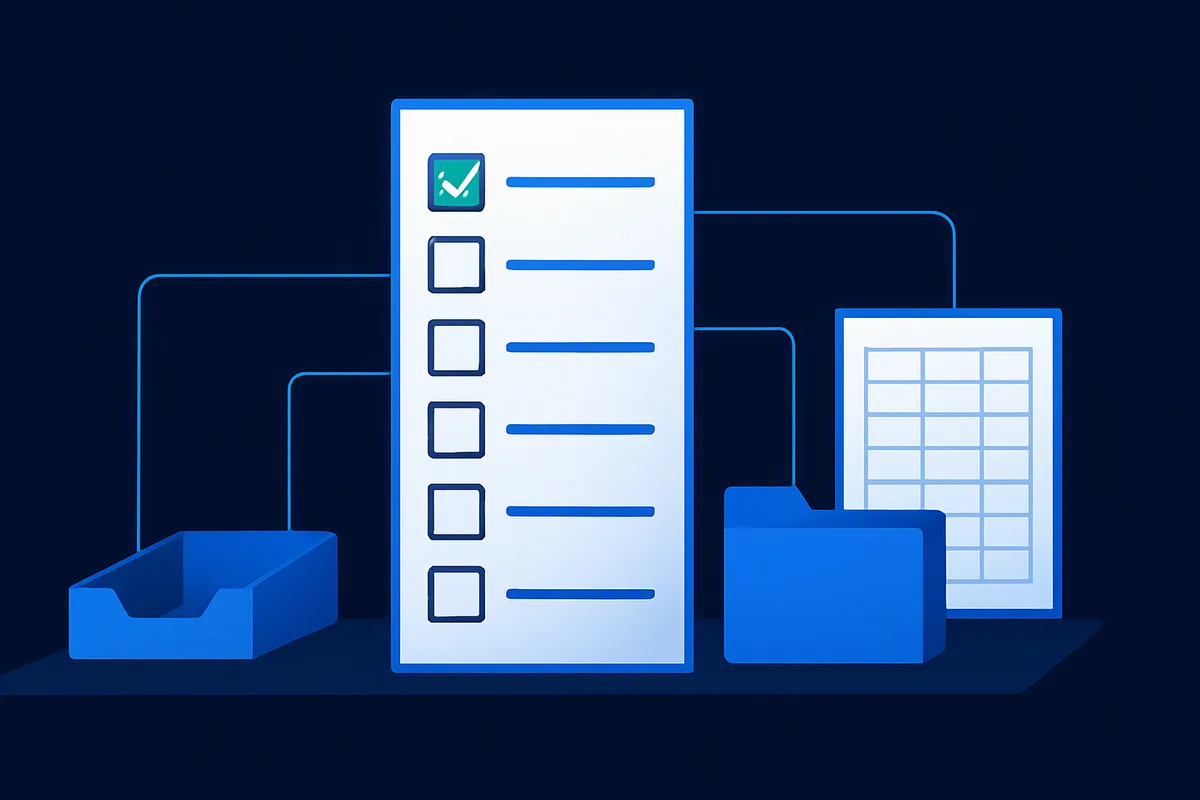
According to MaintainX's 2024 survey, unplanned downtime costs average about $25,000 per hour and rise above $500,000 per hour for larger organizations. In many plants, the warning sits in one system while the repair work, parts, and production window sit in others. That split is what turns known asset risk into waiting time.
Maintenance backlogs turn known asset risk into waiting time: diagnosis waits for a technician, a ticket waits for approval, the truck waits for parts, and production waits for a slot that may not come until the asset fails on its own. Predictive maintenance helps only when it is run as an operating process from signal to work order to parts readiness, not as an anomaly model that drops another alert into the queue.
The cost of failure is not evenly spread. According to MaintainX, 72% of facilities said higher parts and shipping costs were contributing to increased downtime costs, and a 2025 study reported that spare-part-related work orders made up about 65.1% of maintenance cases in its CMMS dataset. The bottleneck is often whether the right part is on hand, reserved, or even identifiable in the first place.
Backlogs persist because maintenance is still managed as a set of handoffs
In many plants, backlog prioritization is reactive. A work order rises because someone escalates it, not because failure probability, safety consequence, production loss, and lead time were evaluated together. A vibration change may be visible in a historian, but the CMMS still behaves as if the finding arrived from a walkdown or a phone call.
That split between detection and execution explains why predictive maintenance often disappoints. Sensors can raise alarms all day, but if the work order contains only an asset number and a symptom, the technician still has to reconstruct the failure mode, search the manual, confirm the likely part, and decide whether the job can be done in the next outage window. The clock keeps running while the organization does what it already did before the model existed.
Deferred work makes this worse. Each time a corrective task is postponed, the eventual repair tends to become more expensive, more urgent, and more disruptive. The plant then pays in overtime, expedited shipping, collateral damage, and lost production. Backlog is a delayed failure queue.
The useful system connects condition, context, and execution
The strongest predictive maintenance programs start by giving the asset one identity across the historian, CMMS or EAM, ERP, drawings, and parts catalog, with timestamps that let events line up. Only then can a temperature trend, pressure change, or current signature be tied to the machine, its maintenance history, its operating mode, and the open work already waiting on it.
From there, the model has to do more than flag an anomaly. It should validate the likely failure mode, estimate confidence, expose lead time, and send that result into a review queue that can create a condition-based work order. A useful work order is specific: due window, skill requirement, safety prerequisites, supporting trend, and likely parts. That is the difference between a notification and a decision.
Parts readiness sits in the same chain. A prediction only helps operations if it is linked to the bill of materials, stock location, reservations, supplier lead times, purchase orders, and repairable spares record. The action may be to reserve, kit, inspect, or order a part. Automatically buying parts because a model is uneasy is how a maintenance tool becomes a procurement problem.
If the process is well designed, the planner stays in control. The system drafts the work order, retrieves the relevant inspection route or prior closeout note, and explains why the task is urgent. A human approves release, isolation, and procurement decisions. That is the point of the architecture, and the reason it can be audited.
- 01Source signalsCollect operating and maintenance data from the asset and its business context.
- Sensors and controllers
- Historian or event stream
- CMMS and ERP feeds
- 02Asset identity layerMatch each signal to the correct machine, configuration, and maintenance history.
- Master asset registry
- Timestamp alignment
- Document and parts catalog links
- 03Prediction and retrievalEstimate likely failure mode and pull the supporting evidence and procedure set.
- Feature extraction
- Anomaly detection or supervised model
- Retrieval index over manuals and work orders
- 04Work and parts planningConvert the prediction into a draft work order and a parts decision.
- Rules engine
- Parts availability lookup
- Review queue
- 05Approval and schedulingPut the task into the right outage window with accountable human signoff.
- Planner approval
- Maintenance scheduler
- Audit log
- 06Execution and feedbackComplete the job and feed the outcome back into the models and records.
- Technician closeout
- Failure code update
- Model evaluation store
- Role-based access and separation of duties across planning, procurement, and release
- Human approval for work order release, part substitution, isolation, and restart
- Audit logging for alerts, decisions, and model version changes
- Evaluation against false alarms, missed failures, lead time, and maintenance outcomes
| Capability | Azure | AWS | Google Cloud |
|---|---|---|---|
| Event stream and sensor ingestion | Azure Event Hubs | Amazon Kinesis | Pub/Sub |
| Operational data storage | Azure Data Lake Storage | Amazon S3 | Cloud Storage |
| Retrieval index and search | Azure AI Search | OpenSearch Service | Vertex AI Search |
| Model training and deployment | Azure Machine Learning | Amazon SageMaker | Vertex AI |
| Workflow and approvals | Logic Apps | Step Functions | Workflows |
What has to be connected before the model becomes useful
This is where the data work matters more than the model choice. Operational technology, maintenance execution, asset engineering, inventory, production context, and safety records all have to be linked through governed identifiers. IEC 63270 guidance treats those interfaces and data requirements as foundational, which is the right way to think about it. Without that spine, the model learns fragments and the plant gets fragments back.
Free-text work orders are a particular liability. Missing failure codes, inconsistent closeout notes, and duplicate asset names weaken both analytics and search. Spare-parts data can be just as bad, with obsolete equivalents, duplicate SKUs, and inaccurate on-hand quantities making a predicted part operationally unsafe. Many plants do not have a predictive maintenance problem first. They have an asset master, catalog, and work-quality problem that makes prediction unreliable.
That is why a retrieval index over manuals, engineering notices, inspection routes, and prior work orders is so valuable. It gives the technician the document, not just a generated answer. Used well, it shortens diagnosis by surfacing the exact failure code, the correct procedure version, and the maintenance history of that configuration.
Where the approach pays off and where it does not
The payoff comes when the system is allowed to change timing, not just awareness. A validated prediction can move a task into a planned outage, prevent an unnecessary teardown, or create enough lead time to have the part on hand. According to a 2025 study, a comprehensive predictive-maintenance program was associated with a 41.6% reduction in unplanned downtime, a 37.4% reduction in mean time to repair, and a 29.3% reduction in spare-parts holdings. Those results are study-specific and should be checked against the plant, asset class, and operating regime before anyone uses them as a forecast.
The limits are just as real. Predictive maintenance fails when failure labels are sparse, when equipment changes faster than the model can be revalidated, or when plant leaders treat alerts as a substitute for scheduling authority. It also fails when production incentives reward short-term output more than avoided failure, because then the backlog gets larger while the signal gets quieter.
The safest deployments start narrow. They focus on one asset class, one failure mode, and one workflow that is already expensive enough to deserve scrutiny. Then they measure false-alert burden, detection lead time, missed failures, parts availability, and the time between signal and approved work order. If those measures do not improve, the organization does not have a model problem. It has a process that will not absorb the model.
For operators, the decision is blunt. Either predictive maintenance is wired into the CMMS, the storeroom, and the scheduler, or it remains a dashboard that tells you what you already feared. If the workflow you want gone is the delay between sensor signal and a ready work order, tell us the workflow you want gone, we build it in your environment in two weeks, and you pay $10,000 only after it meets the acceptance criteria you signed off on. QueryNow can help you design that path without adding another alert that nobody can action.
Ready to ship AI in your organization?
We build one workflow into a working tool in two weeks. You pay $10,000 only after every acceptance criterion you signed off on is met.
One workflow · Two-week build · $10,000, paid on delivery
QueryNow
QueryNow deploys production AI for enterprises on Azure, AWS, or Google Cloud. Founded in 2014, we help pharma, healthcare, manufacturing, and financial services organizations deploy governed AI systems. We build it, you pay when it works.
Learn more about us →