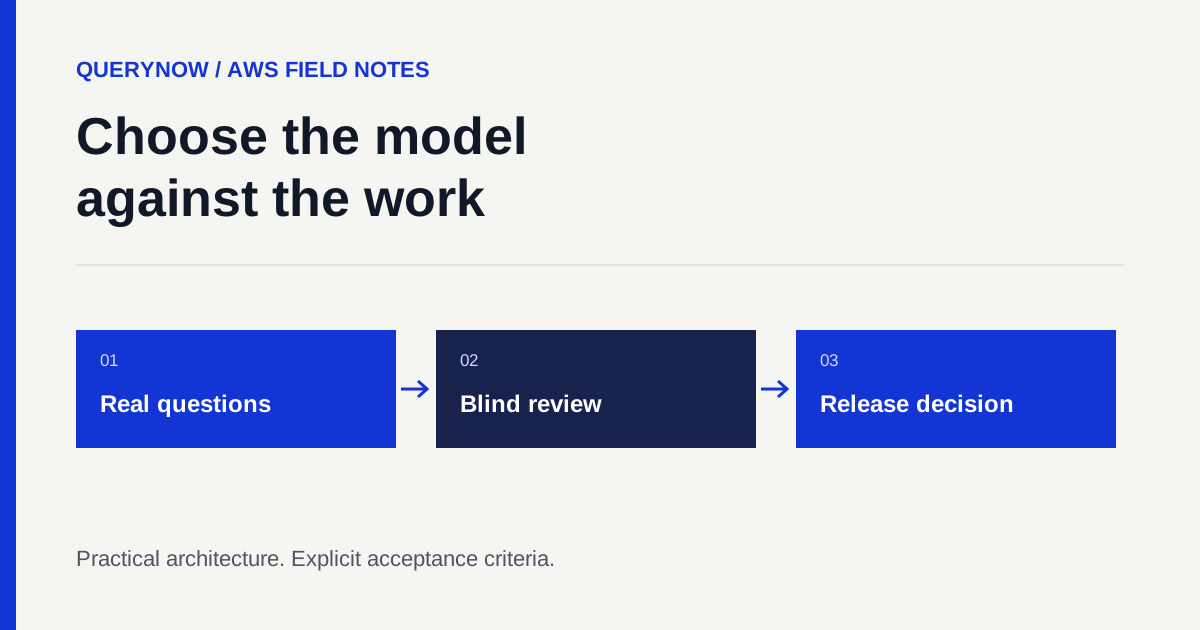
A model demonstration answers the questions selected for the demonstration. Your operations team needs to know what happens with the incomplete request or the document that contradicts last month's guidance. That difference belongs in the evaluation set.
For an Amazon Bedrock application, start with one business decision: can this configuration complete the agreed workflow well enough to release? A broad leaderboard score cannot make that decision for your organization.
Collect questions before tuning prompts
Ask the process owner for representative requests, including the cases people escalate today. Remove unnecessary personal data and document the expected result. Reserve a set of questions that the implementation team will not use during prompt tuning.
For a document assistant, label the evidence that should support each answer. Include questions that cannot be answered from the approved collection. For an extraction task, record the expected fields and the conditions that require human review.
Separate retrieval failures from model failures
If the correct source never reaches the model, changing the model may conceal the problem rather than fix it. Log which passages were retrieved and inspect them before evaluating the final answer. A retrieval failure and a reasoning failure need different corrective work.
Run an additional test with the expected evidence supplied directly. Comparing these results helps identify whether the bottleneck sits in source preparation, retrieval, or response generation. Keep the test conditions consistent across model candidates.
Use a rubric that a reviewer can apply
Define what makes an answer acceptable in business terms. For policy search, a reviewer might check whether the conclusion follows the cited policy and whether the answer omits an important exception. A polished tone cannot compensate for an incorrect instruction.
Amazon Bedrock supports model evaluation workflows. Whether you use a managed evaluation job or an application-specific harness, keep a human-reviewed sample. Automated scores are useful evidence, but the process owner should understand their limits before they become release gates.
Measure the complete task cost
Record the number of model calls per completed task. Add retrieval and orchestration costs where they apply. Include retries and human review effort in the comparison. A cheaper model call can produce a more expensive workflow if it sends more work to a reviewer.
Measure response time from the user's request to a usable result. An isolated model latency number does not capture retrieval, identity checks, or a slow downstream system. Use a workload mix that resembles the planned release.
Make the release decision reproducible
- Version the evaluation dataset separately from the prompt configuration.
- Record the model identifier and inference settings used for every run.
- Keep denied-access and unsupported-question tests in the release gate.
- Retain the review rubric with examples of acceptable and unacceptable answers.
- Run the held-out set again when the source collection or model configuration changes.
Agree the required pass rate with the business owner before reviewing the final candidates. If a critical failure class is unacceptable, treat it as a separate gate rather than averaging it away. The release decision should show which risks remain and who owns them.
Put one workflow into production
QueryNow scopes AWS AI workflows around your existing systems. We agree the deliverables and acceptance criteria before the build. One bounded workflow starts at $10,000, payable only after every agreed criterion is met. We build it in your environment in two weeks. Wider data programs are scoped separately, and AWS usage is separate from the build fee. Tell us the workflow.
Technical references
Ready to ship AI in your organization?
We build one workflow into a working tool in two weeks. You pay $10,000 only after every acceptance criterion you signed off on is met.
One workflow · Two-week build · $10,000, paid on delivery
QueryNow
QueryNow deploys production AI for enterprises on Azure, AWS, or Google Cloud. Founded in 2014, we help pharma, healthcare, manufacturing, and financial services organizations deploy governed AI systems. We build it, you pay when it works.
Learn more about us →