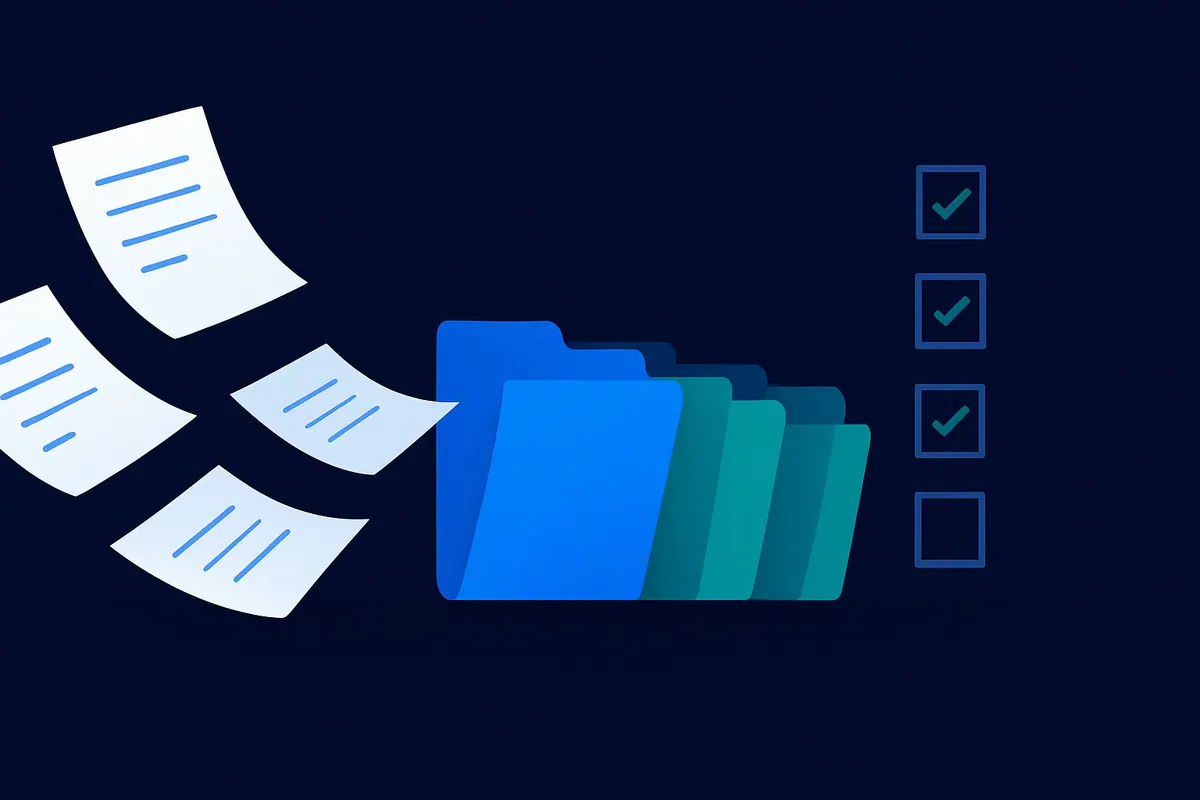
An accounting engagement often slows down before the accounting begins. A document arrives without a clear period, or a statement turns up twice. A client sends most of the requested files but misses one item, and staff spend time sorting, matching, and asking follow-up questions.
That preparation is a practical place to introduce AI. The system can organize incoming information and prepare a reviewable list of missing items. Your accountant can then spend less time reconstructing what arrived and more time evaluating what it means.
The first project should cover a specific recurring service. Monthly bookkeeping intake is different from a tax engagement or an audit, so start with the checklist and evidence requirements for one process.
Turn the checklist into a working process
Define the client, engagement, reporting period, and required document categories. Make those fields explicit before adding AI.
When a file arrives, the assistant can identify its likely type and period, then attach it to the relevant checklist. A deterministic check should catch duplicate references and inconsistent dates, and ambiguous client matches should go to a person.
The output should explain why an item appears missing. A coordinator can then approve a request such as asking for a particular month's statement, instead of sending a generic reminder for documents the client may already have provided.
The system should also distinguish missing from unreadable. Repeatedly requesting a file that is present but cannot be parsed creates unnecessary frustration.
Keep accounting judgments with the accountant
A complete checklist does not establish that the evidence is sufficient or correct. A document may contain unexplained transactions, the wrong entity, or a discrepancy that requires follow-up.
The assistant can surface those questions and assemble source links, but it should not quietly treat them as resolved. The accountant decides whether the work can proceed.
Use structured software for calculations, reconciliations, and validation rules. A language model can describe a variance, but the underlying amounts should come from a checked calculation, and a fluent explanation should never hide a failed reconciliation.
Protect client boundaries
Client identity is a critical control, because a correct summary attached to the wrong client is a serious failure. Test mixed-client files, similarly named businesses, subsidiaries, and documents containing several periods. Limit the assistant to the information needed for the task, and protect intermediate text and generated summaries as well as the original files.
The FTC's guidance on its Safeguards Rule identifies tax preparation firms among the activities that can fall under the rule. Separately, Section 7216 can restrict disclosure and use of tax return information, as the IRS explains in its Section 7216 information center. Review the applicable rules and exceptions before sending that information through a provider or reusing it for another purpose.
For a first pilot, redacted bookkeeping examples may be sufficient. Keep restricted material outside the approved data flow until its processing has been reviewed.
Learn from large firms without borrowing their numbers
BDO has publicly described an internal AI platform supported by training and governance. That combination matters, because people need to understand the tool and the process around it. Its reported time savings should not be used as a forecast for a smaller practice's intake workflow, where the economics depend on the number of recurring packets, the quality of client submissions, and the amount of coordinator and accountant review that remains.
Count the whole year
Consider a hypothetical firm with 800 eligible packets every month. Reducing handling time from 18 minutes to 10 minutes would recover about 107 hours monthly.
At an assumed $50 loaded cost, gross time value is about $5,333. Applying a 70% realization factor and subtracting $1,200 in monthly operating costs produces about $2,533 of hypothetical net capacity value.
The monthly volume is the key assumption. If the work occurs mainly during a short filing season, multiplying that benefit by twelve would overstate the return, so build the annual model from actual monthly volumes.
Also ask what changes after intake. If accountants spend longer correcting the new review pack, some of the apparent saving has moved to a more expensive employee.
Pilot with representative exceptions
Use examples that cover different document types, file quality, client sizes, and reporting periods. Include empty scans, missing pages, duplicates, and a packet with every expected category but an unresolved accounting issue.
Evaluate client and period matching separately from document classification, and measure unnecessary follow-up requests along with the time spent reviewing drafts. All client messages should stay under human approval during the pilot.
A useful dashboard shows packet status, unresolved items, average active time, corrections, and waiting time. These measures explain where work is improving and where the process is simply moving a bottleneck.
Decide whether a custom build is needed
Your client portal or practice-management software may already support checklists, reminders, and document classification. Review those features before building a parallel workflow.
A custom project makes sense when your process spans several systems or needs firm-specific rules that existing tools cannot express. Keep the first contract small enough to prove that gap.
QueryNow's AI services for accounting firms can start with one recurring intake process. Bring a redacted packet, the checklist, and an example of a follow-up that required manual investigation. Those examples are enough to begin defining a useful pilot.
Questions accounting teams ask
Can the assistant post journal entries?
That is a separate workflow with its own authorization and reconciliation controls. It is not part of the intake scope described here.
Does an enterprise subscription settle confidentiality?
It is one part of the assessment. Data flows, permissions, contractual terms, and applicable disclosure rules still matter.
What is the first result to prove?
Show that correctly matched, review-ready packets take less total staff time without increasing errors or unnecessary client requests.
Ready to ship AI in your organization?
We build one workflow into a working tool in two weeks. You pay $10,000 only after every acceptance criterion you signed off on is met.
One workflow · Two-week build · $10,000, paid on delivery
QueryNow
QueryNow deploys production AI for enterprises on Azure, AWS, or Google Cloud. Founded in 2014, we help pharma, healthcare, manufacturing, and financial services organizations deploy governed AI systems. We build it, you pay when it works.
Learn more about us →