Contents 8 sections
Three of the breaches reported last week started the same way. The attacker used a key or a role that the company had handed to a vendor, and in two of the three cases that vendor was an AI supplier.
If I ran security for a mid-size company this week, I would not start by buying anything. I would start with a list of everything a vendor can open in my systems, because that list is where these attacks began.
What happened
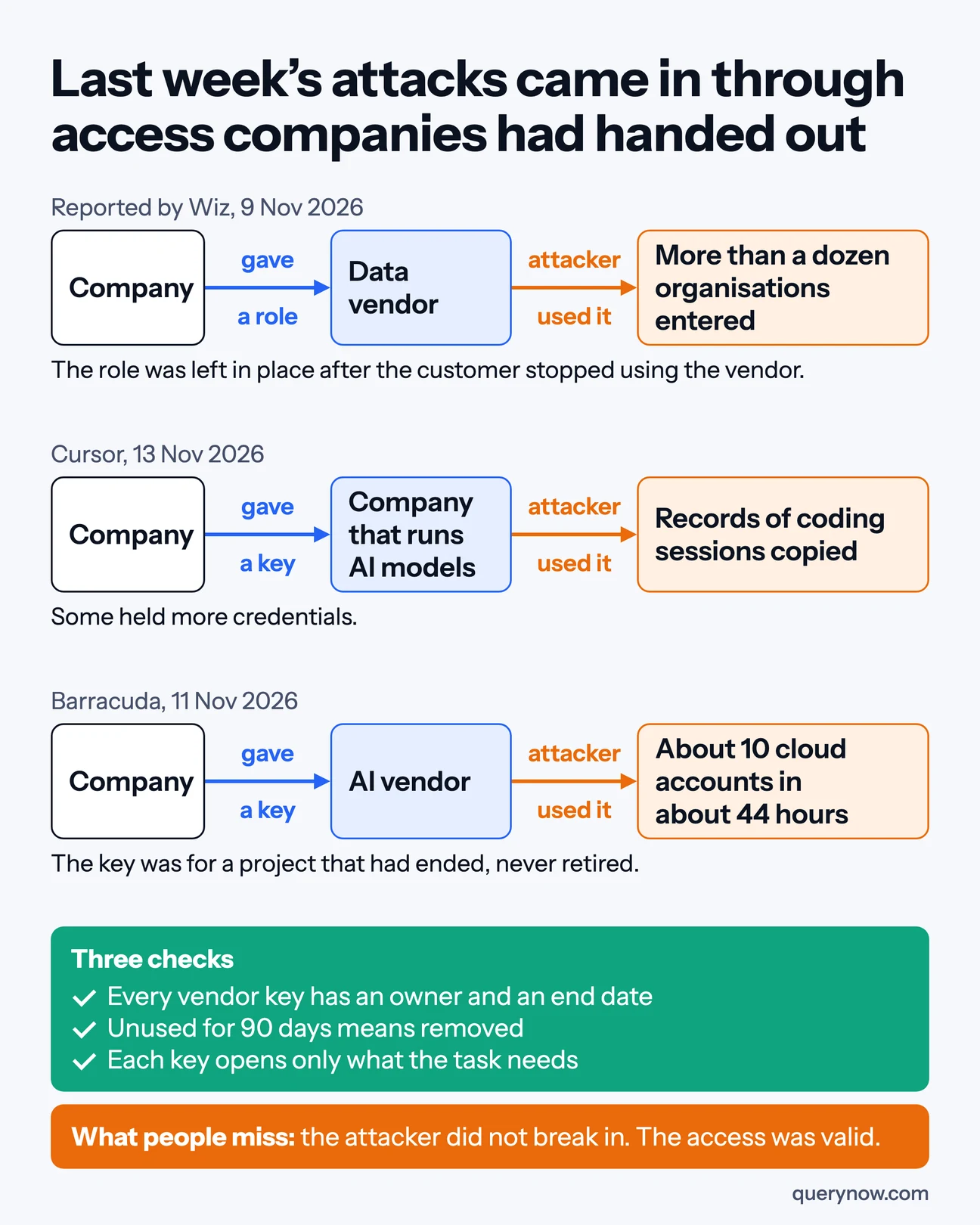
On 9 November the security firm Wiz reported that an attacker had used the cloud credentials of Qubole, a data platform company, to step into roles that Qubole's customers had created for it. The activity ran from 14 to 26 October and reached more than a dozen organisations. Wiz found that many of them had stopped using Qubole and had never removed the role, so the door was still there and it still opened.
On 13 November Cursor, which makes an AI coding tool, said a key it had issued to Fireworks AI was exposed through Fireworks, a company that ran AI models for it. By Cursor's account the attacker used the key to copy stored records of coding sessions, and some of those records held credentials that opened other tools.
Barracuda described a similar start on 11 November. An attacker used a valid cloud key that Barracuda had given to an outside AI vendor for a project that had already ended. Nobody had retired the key, and it took the attacker through about 10 cloud accounts in about 44 hours.
Email was the other way in
Two more events that week aimed at the same prize, a credential the rest of the system then trusts. Microsoft's updates of 10 November fixed an Outlook flaw, CVE-2026-124194, that was already being exploited and that exposes a user's password hash. On 13 November a large campaign sent fake Microsoft 365 service notices, which Microsoft's threat team described three days later as likely password theft.
Why agents make this faster
On 13 November the FBI published a notice about ARTEX, an open source framework that uses an AI model to drive an intrusion step by step. The notice says some intrusions went from first targeting to administrator access in under three hours, and the techniques it lists include vendor credentials and the trust between partner cloud accounts. A leftover key was always a risk. An agent that chains the steps in hours leaves a company far less time to notice.
Agents are also a target. Many of them reach other systems through small connector programs called MCP servers. On 16 November AWS disclosed a flaw in one of its own, now fixed, where text hidden in something the agent read could make the server send its database secret to an address the attacker chose. The bulletin does not report any exploitation, and I would still plan for more flaws of this kind.
What I would do this week
- List every key and role a vendor holds in your systems, AI vendors included. Put an owner and an end date next to each one, and remove any that nobody has used in 90 days.
- Cut each remaining key down to what the work needs. Keep passwords and keys out of the logs and records you share with a vendor, because copied records were what turned one stolen key into several at Cursor.
- Give every AI agent its own identity with only the access its task needs, and review the permissions your applications have been granted. The FBI notice recommends least privilege for exactly those grants.
- Decide which tool servers an agent may use and which addresses those servers may contact. The AWS flaw worked because the server would connect anywhere it was told to.
- Tell staff where real service notices appear, and move sign-in to methods that resist phishing, such as passkeys. Microsoft gave the same advice after the fake notices.
How I would check it was done
| Check | What proves it |
|---|---|
| Every vendor key has an owner and an end date | A register with the last sign-in date on each line |
| Retired access is really gone | A test call with an old key that gets refused |
| Every agent signs in as itself | An agent list matched to the identity directory, with an owner per agent |
| Agents cannot reach unlisted tools | A refused call to a tool server that is not on the list |
None of this stops a vendor from being breached. It limits what the stolen access can open, which is the part you control. It is also dull work, and the register goes stale unless closing a vendor contract closes its access on the same day.
How many vendors still hold a key to your systems after their project ended?
Where QueryNow fits
QueryNow builds AI agents and the foundation they run on, on Microsoft Azure and AWS. Our AI agent security audit starts with the inventory described here, and the full checklist with the evidence for each item is in the white paper Zero trust architecture for AI.
Sources
- Wiz, Qubole cross-account access abused in the wild, 9 November 2026
- SecurityWeek, Over a dozen organizations hit in Qubole supply chain attack, 10 November 2026
- Cursor, Security incident update, 13 November 2026
- Barracuda, Forty-four hours: anatomy of a machine-speed intrusion, 11 November 2026
- Microsoft Security Response Center, CVE-2026-124194, 10 November 2026
- Microsoft Security Blog, phishing campaign using Microsoft 365 service notices, 16 November 2026
- FBI, FLASH-20261113-001 on ARTEX, 13 November 2026
- AWS security bulletin 2026-185, 16 November 2026
QueryNow leads AI transformation for enterprises in the US and Europe. Founded in Germany in 2014, we build the foundation enterprise AI runs on, and the agents that run on it, for pharma, healthcare, manufacturing and financial services organizations on Azure and AWS.
FAQ
Frequently asked questions
How did the attackers get in?
In the three cases described here they used access the company had given to a vendor: a role created for a data vendor (reported by Wiz on 9 November 2026), a key issued to a company that ran AI models (Cursor, 13 November 2026) and a key given to an AI vendor for a finished project (Barracuda, 11 November 2026).
What is zero trust, in plain words?
No request is trusted because of where it comes from. Every caller, whether a person, a program or an AI agent, has to prove who it is each time and gets only the access the task needs. The reference text is NIST Special Publication 800-207.
What should a company do first?
List every key and role that a vendor holds, give each one an owner and an end date, and remove the ones nobody has used in 90 days. It needs no new product.
Why do AI agents raise the risk?
An agent reads text it cannot verify, acts with someone's access and chains steps quickly. The FBI notice of 13 November 2026 on the ARTEX framework says some intrusions reached administrator access in under three hours.
The Monday digest
The three posts worth your time each week, one paragraph each. From the people building production AI.