Contents 6 sections
If my company ran AI on AWS, the first thing I would check is whether anyone could tell me what our models were asked last week. On an account where nobody has changed the default the answer is no, because full logging of model calls is off until someone turns it on.
AWS has strong parts for a zero trust design, where no caller is trusted because of where it sits and every request has to prove who is asking. It also has a few defaults and gaps that are easy to walk past. This is the order I would build in and what I would check at each step.
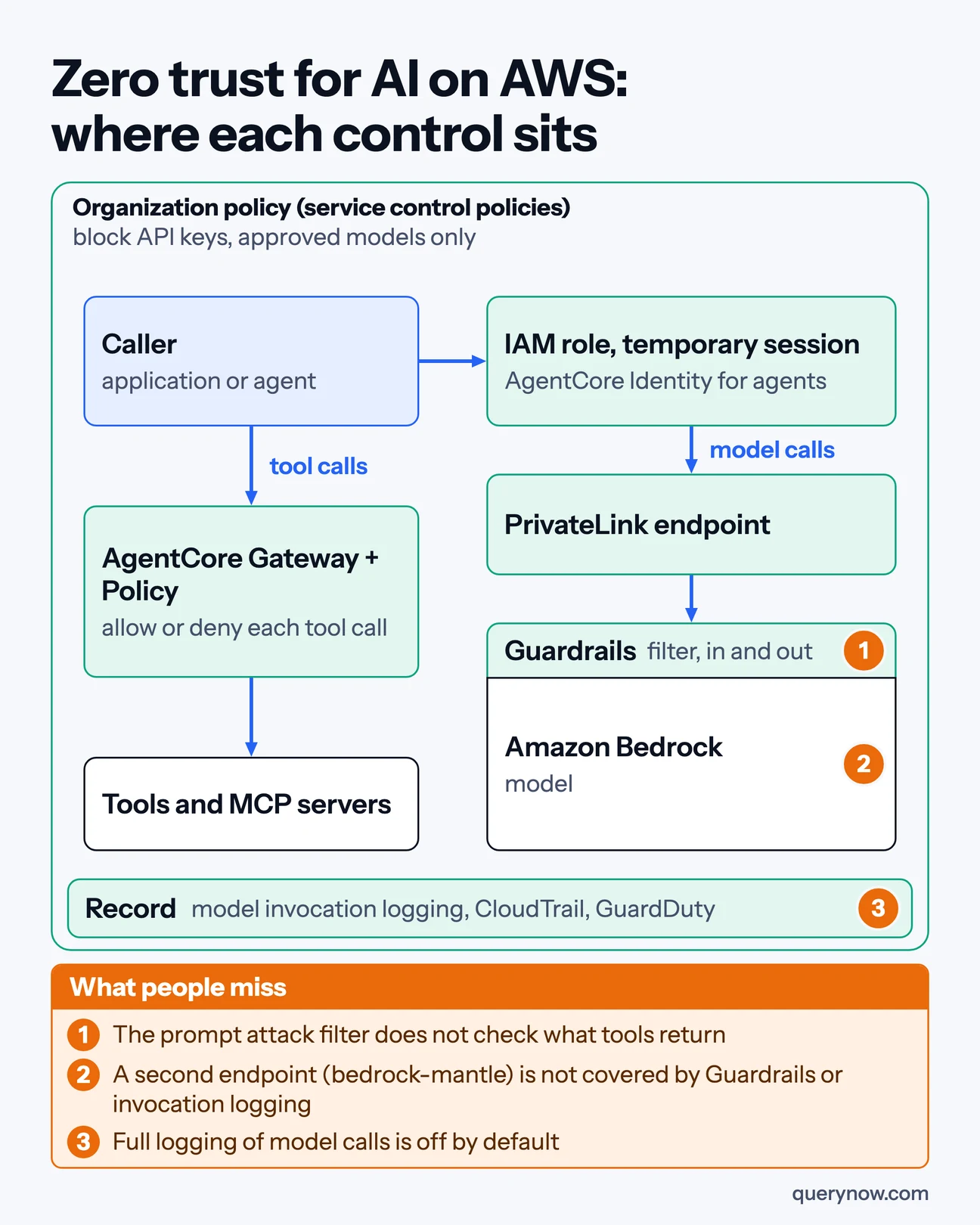
The order I would build it in
1. Turn on the record
On Bedrock's main endpoint, CloudTrail records that a model was called and by whom. The text that went in and the answer that came out are kept only after you turn on model invocation logging, and AWS's own page says it is disabled by default. Turn it on in every account and Region first, so that you can see the effect of everything you change afterwards.
2. Roles for applications, an identity for every agent
An application on AWS should call the model through a role that gives it a temporary session, one hour by default. For agents, Amazon Bedrock AgentCore Identity gives each one its own identity. When an agent acts for a person, it can swap that person's sign-in for a token limited to one system that names both of them.
There is one permission I would deny in production. It lets a caller ask for a token on behalf of a user ID that the caller simply supplies, with no check that the user signed in. A full-access managed policy grants it, and AWS itself recommends denying it.
3. Block the API keys
Amazon Bedrock accepts API keys, and a key works for anyone who holds a copy. AWS documents no single switch that turns them off. You deny the action that lets a key be used, and you have to deny it twice, once for each of Bedrock's two endpoints, or the second one stays open. Short-term keys cannot be stopped from being created and cannot be revoked one at a time, so the deny on use is the control that counts.
4. A private path, with a policy on it
PrivateLink puts a private entry point for Bedrock inside your own network. Its default policy allows full access, so someone has to write one that names the callers and actions you permit. Then list what still goes out. Calls from the tool gateway to outside tool servers leave AWS's network, and the browser tool needs the internet.
5. A rule on every tool call
Here AWS is further along than most. AgentCore Gateway puts tools behind one entry point, and a policy engine decides each tool call before the tool runs. The rule can name the caller and the tool and can test the values being passed, and it sits outside the agent's code. It has been generally available since March 2026.
The catch is the gateway's own role. Every caller of a gateway shares its permissions as an upper limit, so AWS advises a separate gateway for each group of callers that should not share access.
6. Inspect what goes in and out
Bedrock Guardrails filters prompts and answers, and a policy condition can require that every model call names an approved guardrail. Know what it does not see. AWS says its filter for prompt attacks does not evaluate what tools return to the agent, so an instruction planted in a tool result falls outside it. That is why the tool rule in step 5 matters more than the filter.
7. Hold it in place across accounts
Access to a Bedrock model turns on the first time someone calls it. So use organization policy to deny the models you have not approved, to keep the key deny in every account, and to require the guardrail.
The gap I would look for first
Bedrock has a second endpoint, named bedrock-mantle. AWS documents that Guardrails do not run on it and that model invocation logging does not cover it. Calls to it reach CloudTrail only if you opt in, and under a different source name, so a detection rule written for the main endpoint will not see them. If your teams use it, treat it as a separate system and decide who may call it.
How I would check it was done
| Check | What proves it |
|---|---|
| Model calls are logged in full | One sample log entry with prompt and caller, from every account and Region in use |
| Keys cannot be used | A refused call with a key on each of the two endpoints |
| The model cannot be reached from the internet | A refused call from outside, and the endpoint policy naming who may call |
| Tool calls are decided by policy | A refused call to a tool the agent is not allowed to use |
| Only approved models can be called | A refused call to a model that is not on the list |
One caution on Claude. Claude on Amazon Bedrock and Claude Platform on AWS are different products. Anthropic operates the second, and its documentation says customer data may be held outside AWS, so check which one a team has bought before you assume the controls above apply.
Which of your AWS accounts keeps a record of what your AI models were asked?
The same build on other clouds is in the articles on Microsoft Azure and Google Cloud.
Where QueryNow fits
QueryNow is a Microsoft partner that also builds on AWS, with teams in Texas and Munich. Our AI agent security audit checks the points above on the agents you already run, and the full checklist is in the white paper Zero trust architecture for AI.
Sources
- AWS, Model invocation logging for Amazon Bedrock
- AWS, Amazon Bedrock API keys
- AWS, Permissions for Amazon Bedrock API keys
- AWS, Amazon Bedrock AgentCore Identity overview
- AWS, Workload access tokens in AgentCore
- AWS, Outbound authorization for AgentCore Gateway
- AWS, Interface VPC endpoints for Amazon Bedrock
- AWS, Policy in Amazon Bedrock AgentCore
- AWS, Prompt attacks in Amazon Bedrock Guardrails
- AWS, Amazon Bedrock inference endpoints
- AWS, Access to Amazon Bedrock models
AWS documentation pages carry no date. All were read on 17 November 2026.
QueryNow leads AI transformation for enterprises in the US and Europe. Founded in Germany in 2014, we build the foundation enterprise AI runs on, and the agents that run on it, for pharma, healthcare, manufacturing and financial services organizations on Azure and AWS.
FAQ
Frequently asked questions
What does zero trust mean for AI on AWS?
It means no call to a model or a tool is trusted because of where it comes from. Each application and agent has its own identity, and each request is checked against policy and leaves a record. On AWS the main building blocks are IAM roles, Amazon Bedrock AgentCore Identity, AWS PrivateLink, AgentCore Gateway with Policy, Amazon Bedrock Guardrails, model invocation logging with CloudTrail, and service control policies.
How do you block Amazon Bedrock API keys?
AWS documents no single switch. Its key permissions page shows how to deny the action bedrock:CallWithBearerToken and the matching action under the bedrock-mantle name, since denying only the first leaves the second Bedrock endpoint open. A deny on iam:CreateServiceSpecificCredential stops new long-term keys. The same page says the creation of short-term keys cannot be prevented, so the deny on their use is the control that matters.
Does Amazon Bedrock Guardrails stop prompt injection that arrives through a tool?
Not by its prompt attack filter. The AWS page on prompt attacks, read on 17 November 2026, says the filter does not evaluate tool results, and tool definitions are not checked either. That leaves text returned by tools and retrieved documents to other controls, such as the per-call rules in Policy in AgentCore and narrow permissions on each tool.
Is model invocation logging on by default in Amazon Bedrock?
No. The AWS logging page states that model invocation logging is disabled by default, and it covers the bedrock-runtime endpoint only. CloudTrail records InvokeModel and Converse calls on bedrock-runtime by default, without the prompt text. On the bedrock-mantle endpoint, inference appears in CloudTrail only as an opt-in data event under the source name bedrock-mantle.amazonaws.com.
Is Claude Platform on AWS the same as Claude on Amazon Bedrock?
No, they are two products. Claude on Amazon Bedrock runs in accounts that Bedrock owns, and AWS says model providers have no access to customer prompts and completions there. Claude Platform on AWS is operated by Anthropic, and its AWS documentation says data may not reside in AWS. A company should confirm which of the two a team is using before it relies on Bedrock controls.
The Monday digest
The three posts worth your time each week, one paragraph each. From the people building production AI.