Contents 5 sections
On Google Cloud I would build the network boundary before the first AI agent goes live. On this platform the order decides whether the agent gets the boundary's protection.
Google Cloud has the parts for a zero trust design, where no caller is trusted because of where it sits and every request has to prove who is asking. Several of them are off, open or optional until someone decides otherwise. This is the order I would build in and what I would check at each step. Google renamed Vertex AI to Gemini Enterprise Agent Platform in April 2026, and I use the new name here.
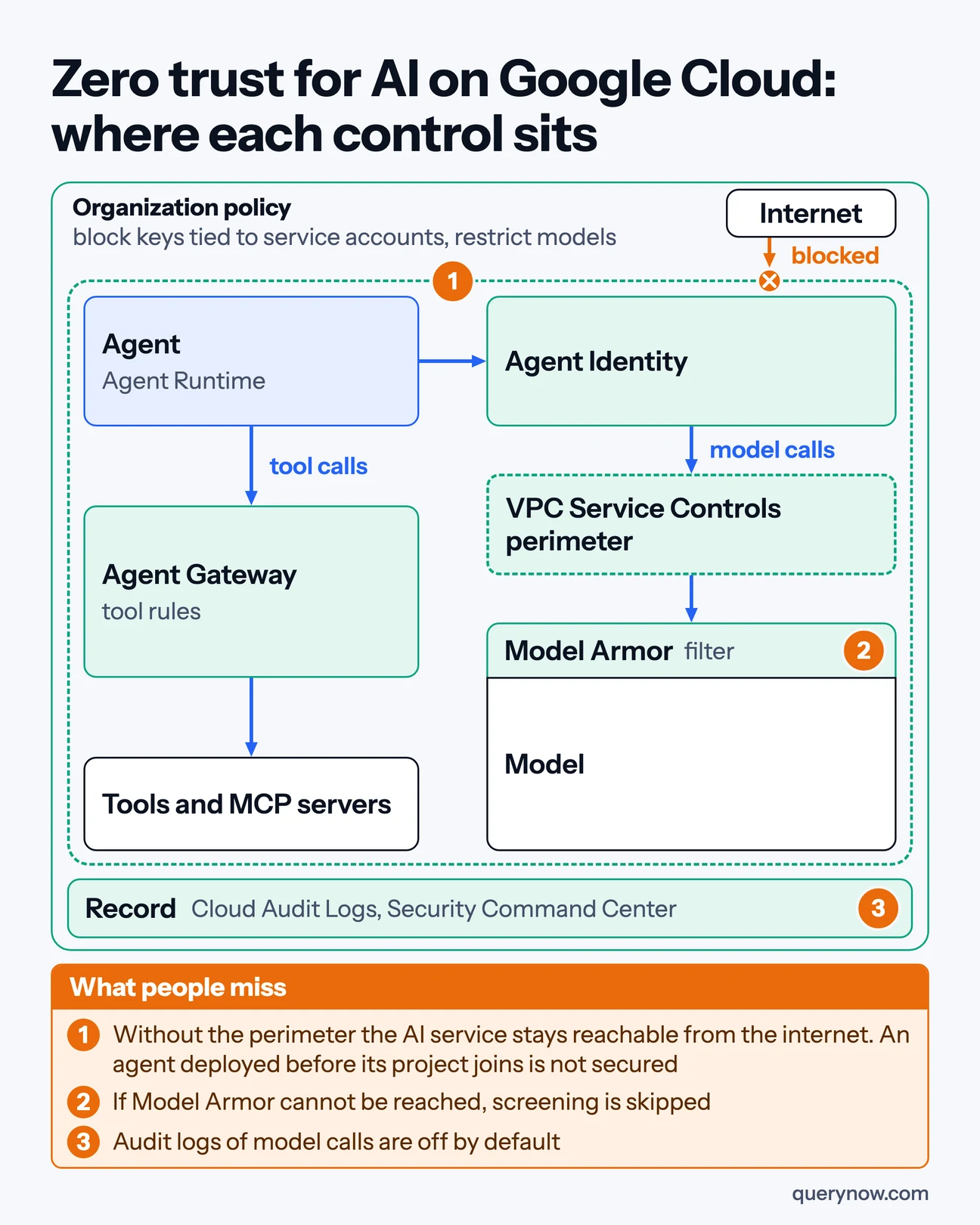
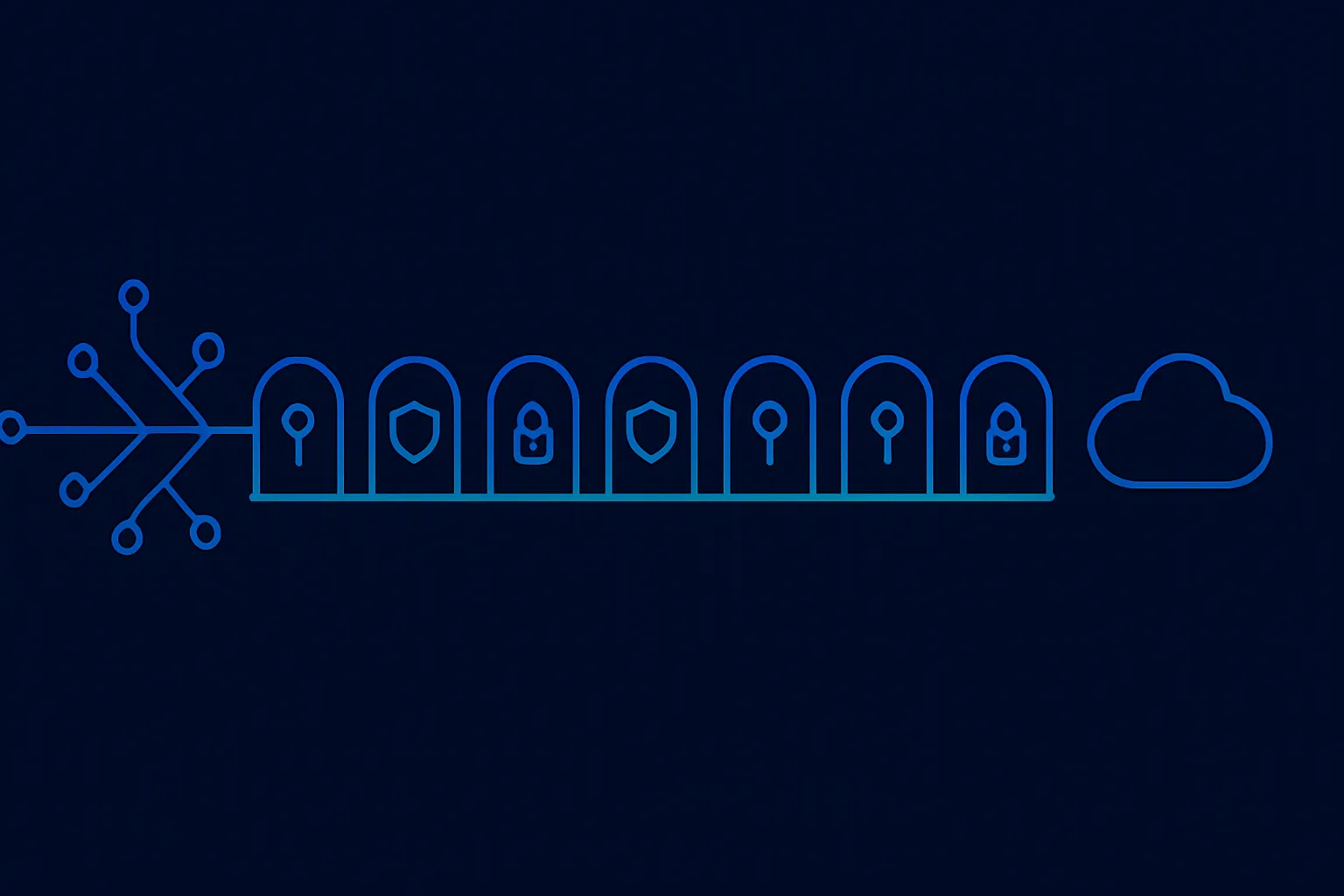
The order I would build it in
1. The boundary first
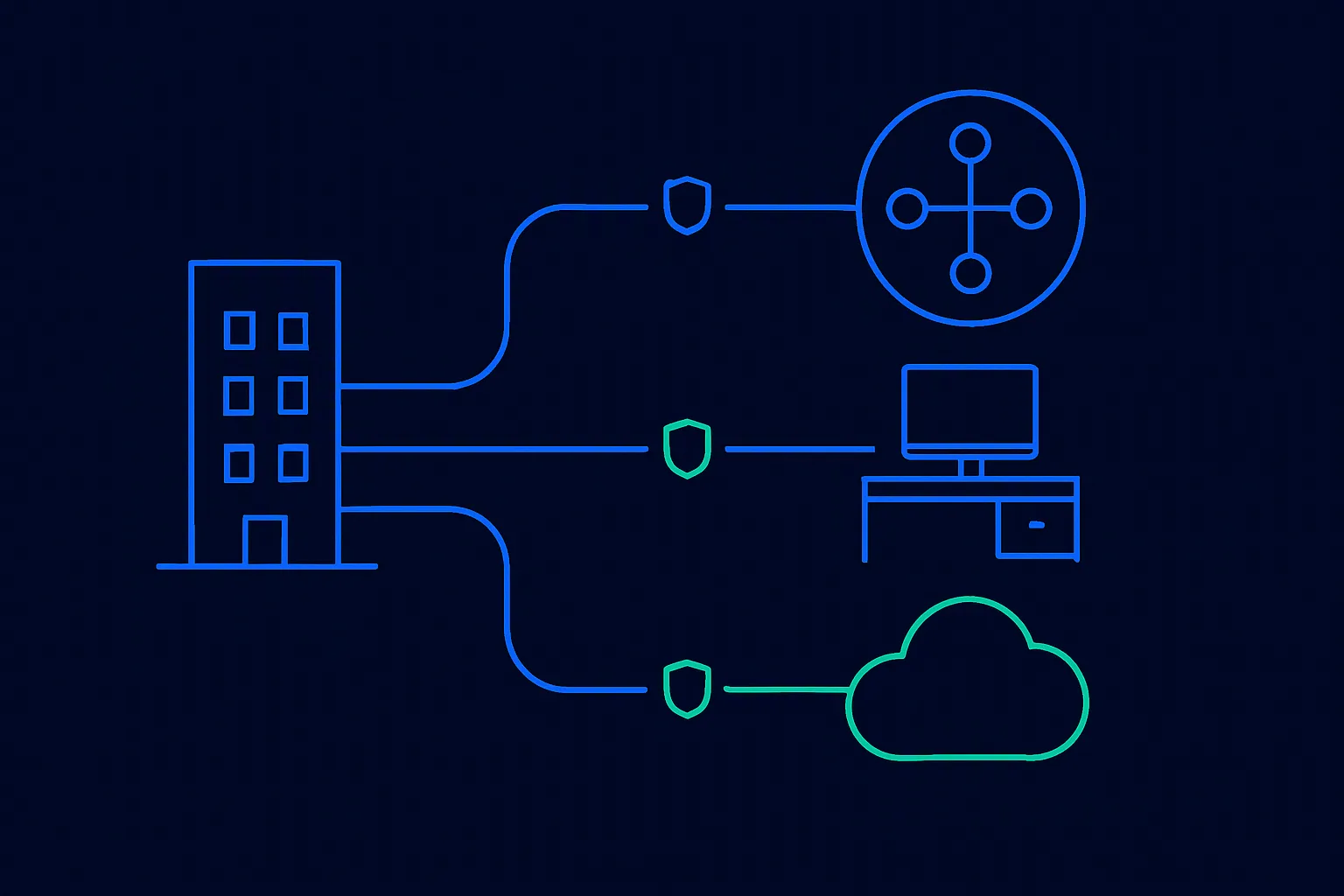
By default the AI service can be reached from the internet, with the permission system still deciding who gets in. Google's documentation says its private connection options add private routes and do not remove that public access. Only a boundary around your projects does, which Google calls a VPC Service Controls perimeter.
The same page says an agent deployed before its project joins the perimeter is not secured. A team that ships the agent first and plans the boundary for later has left that agent outside it, and I would deploy it again once the project is inside. One side effect to plan for: inside the perimeter the model can no longer fetch live web addresses.
2. An identity for every agent
Agent Identity gives each agent its own identity, backed by a certificate that lasts 24 hours and renews by itself. On the service that hosts agents it is opt-in, so someone has to choose it. Google also notes that an agent which is deployed again gets a new identity, so the access you granted to the old one does not carry over. Put the grants in your deployment scripts and not in someone's memory.
3. Decide about keys on purpose
A default rule across the organization already blocks API keys that are tied to a service account. The Gemini API is allowed by default, so that door is open until you decide. Calls made with the quick-start kind of key leave no access logs you can see, which is reason enough to keep those keys out of anything that matters.
4. A rule on tool calls
Agent Gateway is the checkpoint for an agent's traffic to tools, and it blocks a connection unless a policy allows it. Rules for individual tools exist, and Google's own pages disagree on whether they are generally available or still in preview, so test them in your own project. Google also warns against a catch-all rule for unregistered endpoints, because it skips the checks on outbound calls. I would search every policy for one before going live.
5. Inspect what goes in and out, and test the failure
Model Armor screens prompts and answers for planted instructions and sensitive data. In its integration with the agent platform, Google says that if Model Armor cannot be reached or returns an error, screening is skipped and the call continues. It checks each message alone, with no memory of the conversation, and it does not decode text that has been encoded. So I would treat it as one layer, and I would test what my application does when the screen is unavailable.
6. Turn on the record
The audit logs that record model calls are off by default. Turn them on before the first production call. A separate log of request details, without the prompt text, became generally available at the end of October 2026.
7. Hold it in place with organization policy
Organization policy can restrict which models may be used and where resources may run, and since this month it can require an agent identity and an approved gateway. The model rule lists models by name, so one rule does not block every outside model. Review the list each time a new model appears.
How I would check it was done
| Check | What proves it |
|---|---|
| The AI service cannot be reached from the internet | A refused call from outside the perimeter |
| Every agent was deployed after the perimeter | Deployment dates of each agent against the date its project joined |
| Every agent signs in as itself | The agent list with an identity on every row, and the grants in the deployment scripts |
| Model calls are recorded | One sample audit log entry from each project in use |
| The application behaves when screening fails | A dated test with Model Armor made unavailable |
Two cautions. Claude is sold on Google Cloud in two forms. With the one Anthropic runs, data is stored on Anthropic's systems, and Google says to choose the Google-run form if you need the perimeter or Model Armor. OpenAI's models were in private preview there on 17 November 2026, and Google's pages disagree on which security controls cover preview models.
Did your first AI agent go live before or after the network boundary?
The same build on other clouds is in the articles on Microsoft Azure and AWS.
Where QueryNow fits
QueryNow builds AI agents and the foundation they run on, with teams in Texas and Munich. Our AI agent security audit checks the points above on the agents you already run, and the full checklist is in the white paper Zero trust architecture for AI.
Sources
- Google Cloud, VPC Service Controls with Gemini Enterprise Agent Platform
- Google Cloud, Agent Identity overview
- Google Cloud, Use Agent Identity with Agent Runtime
- Google Cloud, Manage API keys
- Google Cloud, Agent Gateway overview
- Google Cloud, Route Agent Runtime traffic through Agent Gateway
- Google Cloud, Model Armor integration with Gemini Enterprise Agent Platform
- Google Cloud, Audit logging for Gemini Enterprise Agent Platform
- Google Cloud blog, What is new in Organization Policy, 12 November 2026
- Google Cloud, Claude models managed by Anthropic
All Google Cloud pages were read on 17 November 2026.
QueryNow leads AI transformation for enterprises in the US and Europe. Founded in Germany in 2014, we build the foundation enterprise AI runs on, and the agents that run on it, for pharma, healthcare, manufacturing and financial services organizations on Azure and AWS.
FAQ
Frequently asked questions
What does zero trust mean for AI on Google Cloud?
It means no caller is trusted because of where it runs. On Google Cloud each application and agent signs in with its own identity, the public route to the model is closed with a service perimeter, tool calls pass through a gateway, prompts and output are inspected, and calls are logged.
What is Vertex AI called now?
Google renamed Vertex AI to Gemini Enterprise Agent Platform on 22 April 2026, according to the Agent Platform release notes. Vertex AI Agent Engine, the service that hosts agents, is now Agent Runtime. Many readers still search for the old name, so both are given here.
Does Private Service Connect make the Google Cloud model endpoint private?
Not by itself. Google's page on VPC Service Controls says Private Service Connect and Private Google Access add private routes without removing the public route to Agent Platform APIs. A VPC Service Controls perimeter is what blocks public access, and an agent deployed before its project joins the perimeter is not secured.
Does Model Armor screen every prompt and response?
Google's integration page says that in the built-in Agent Platform integration, screening is skipped and the request continues if Model Armor is unreachable or returns an error, and also in a region where it is not offered. Documents and file uploads are not screened in that integration. The Model Armor overview adds that each prompt and response is checked on its own, without conversation history, and that encoded text is not decoded.
Are model calls logged by default on Google Cloud?
Admin Activity logs are always on, but Data Access logs, which record model calls, are off by default and have to be turned on. Inference request metadata logging, generally available since 30 October 2026, writes one entry per model call without the prompt or the response. Request-response logging is in preview and is not available under VPC Service Controls.
The Monday digest
The three posts worth your time each week, one paragraph each. From the people building production AI.