Contents 9 sections
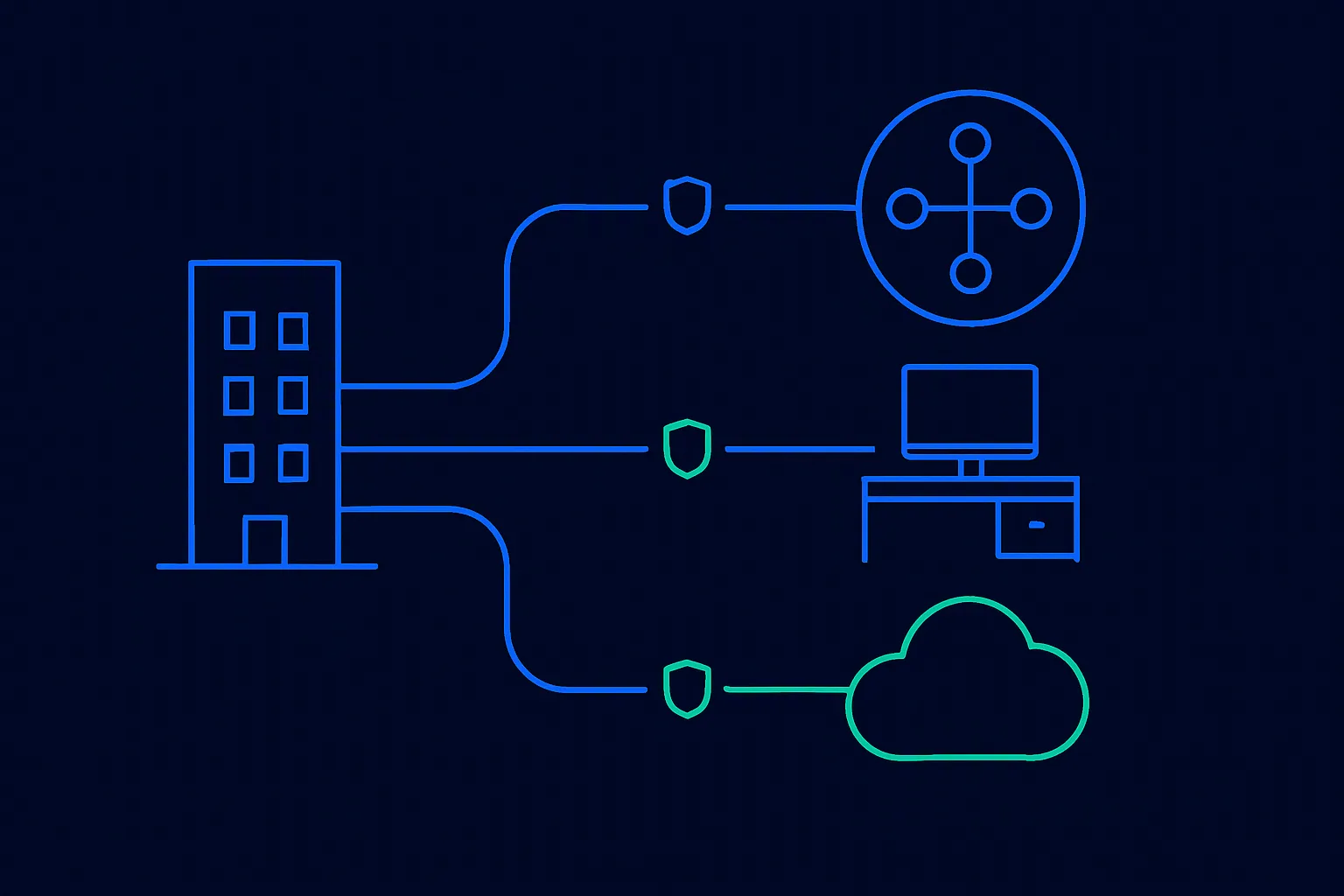
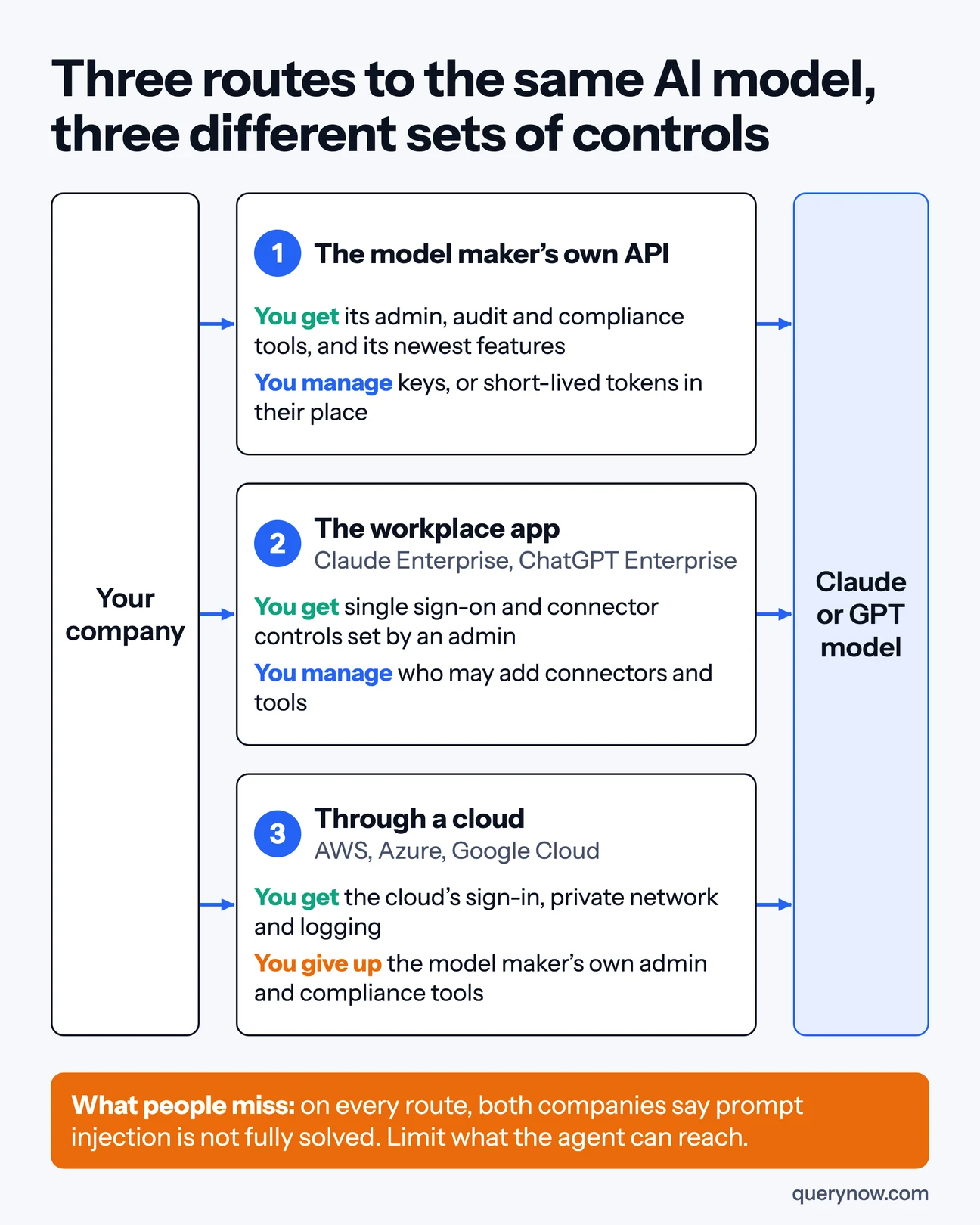
If my team asked whether Claude or GPT is safer for company data, I would first ask which route we use to reach the model. The same model can be reached three ways, and the route decides more of your security than the model does.
Zero trust means no caller is trusted because of where it sits, and every request has to prove who is asking. Anthropic and OpenAI both give you tools for that, and they are different tools on each route. This is how I would choose a route and what I would set on it.
Route 1: the model maker's own API
Choose this when you are building your own application and want the newest features, or the model maker's own admin and compliance tools. I would give each application its own workspace at Anthropic or its own project at OpenAI, with a spend limit on it. That limits how much one misbehaving application can spend or see.
Then replace stored keys. Both companies launched a way in May 2026 for software to swap a token from your own identity system for a short-lived one, so no long-lived key sits in a config file. Both also let you restrict calls to your own network addresses, which at Anthropic was still in beta on 17 November 2026. OpenAI additionally offers a client certificate check on top of the key.
Route 2: the workplace app
Choose Claude Enterprise or ChatGPT Enterprise when staff need a chat and agent application over company documents. Both support single sign-on. Neither documents a setting that forces a second sign-in factor for the whole organization, so I would enforce that at our own identity provider and not rely on the app.
The setting I would look at first is who may add connectors, because a connector is how the assistant reaches other systems. In ChatGPT Enterprise, apps are off by default in a new workspace and only admins and owners can publish a custom tool server. In Claude Enterprise, a role can set each tool to always allowed, needs approval or blocked. Neither page describes one company-wide list of approved tool servers, so that list is something you keep yourself.
If developers use the coding agents, both can be locked from the centre. Claude Code has managed settings that override what a user sets, and Codex has a managed configuration that limits approvals and network access. In both, check that the sandbox, the walled-off area where the agent runs commands, is switched on.
Route 3: through a cloud
Choose this when the data has to stay with a cloud you already audit. Your software signs in with the cloud's identity system, and the cloud's private network and logging can apply, depending on the product. What you give up is the model maker's own layer. Anthropic lists its admin, compliance and usage tools as unsupported when Claude is used through Amazon Bedrock, and OpenAI lists several of its hosted tools as missing there.
Check which product you are buying. On AWS and Google Cloud, Claude is sold in two forms, one where the cloud runs the model and one where Anthropic does, and in the second form data can be processed outside the cloud. On Microsoft Foundry, Anthropic operates both forms.
Two differences that often decide it
The first is location. OpenAI offers processing inside Europe on its own API for eligible organizations. Anthropic's own routes offer global or US processing, so a company that needs Claude processed in Europe has to look at a cloud route and check how each model is routed there.
The second is retention. Both companies keep data for about 30 days as standard and offer zero retention by agreement. At both, zero retention leaves out the features that keep state on the vendor's side, such as stored files and hosted agents. Anthropic also requires 30 days of retention for its newest models unless it has agreed otherwise. If zero retention matters to you, check each feature your application uses against the list.
What neither company has solved
Both say in writing that prompt injection, where text an agent reads carries instructions it then follows, is not fully solved. Anthropic's research team wrote that no browser agent is immune. OpenAI's guide says its measures reduce the risk and do not remove it. So on every route I would limit what the agent can reach and where it can send data, and require a person's approval for any action that cannot be undone.
How I would choose
| If you need | Route | First thing to set |
|---|---|---|
| A chat and agent app for staff | The workplace app | Second factor at your identity provider, and who may add connectors |
| Your own application with the newest features | The model maker's API | One workspace or project per application, short-lived tokens in place of keys |
| Data that stays with a cloud you audit | A cloud, in the form the cloud runs | Confirm which form you bought, then the cloud's identity and logging |
| Processing in Europe | OpenAI's own API if eligible, Claude through a cloud | Check where each model is routed |
These details change quickly. I read both companies' documentation on 17 November 2026, and some of it will be different by spring, so date whatever you write down.
Which route does your company use today, and did anyone choose it?
Where QueryNow fits
QueryNow builds AI agents and the foundation they run on, with teams in Texas and Munich. Our AI agent security audit covers the route your agents use and the controls on it, and the full checklist is in the white paper Zero trust architecture for AI.
Sources
- Anthropic, Workspaces
- Anthropic, Workload identity federation
- Anthropic, API and data retention
- Anthropic, Data residency
- Anthropic, Claude in Amazon Bedrock
- Anthropic, research post on prompt injection, 24 November 2025
- OpenAI, Workload identity federation
- OpenAI, Data residency
- OpenAI, Data controls
- OpenAI, OpenAI models on Amazon Bedrock
- OpenAI, Safety in building agents
Most of these pages carry no date. All were read on 17 November 2026.
QueryNow leads AI transformation for enterprises in the US and Europe. Founded in Germany in 2014, we build the foundation enterprise AI runs on, and the agents that run on it, for pharma, healthcare, manufacturing and financial services organizations on Azure and AWS.
FAQ
Frequently asked questions
What are the three ways a company can use Claude or OpenAI models?
The first is the model maker's API, where your own software calls Anthropic or OpenAI with a credential. The second is the workplace product, Claude Enterprise or ChatGPT Enterprise, where staff sign in to a chat and agent application. The third is a cloud, where a model is called through Amazon Bedrock, Google Cloud or Microsoft Foundry with that cloud's identity system, subject to which models each cloud offers. Each route leaves the company with a different set of controls.
Does zero data retention cover AI agents?
Only in part. Anthropic and OpenAI both offer zero data retention by agreement, and both exclude features that keep state on the vendor's side. Anthropic's exclusions include Batch, Files, the MCP connector, code execution and hosted Managed Agents, and its Fable 5.2 and Mythos 5.2 models require 30-day retention unless authorised. OpenAI's exclusions include Conversations, Assistants, Agents, vector stores, Files and Batch.
What changes when Claude is used through Amazon Bedrock?
Sign-in moves to AWS IAM, and AWS states that model providers cannot see customer prompts and completions. Logging moves to AWS services, and AWS's invocation logging covers the bedrock-runtime endpoint only. Anthropic's page lists its Admin, Compliance and Usage APIs as unsupported on Bedrock, along with the Files API, code execution, the MCP connector, Batches and Managed Agents. Claude Platform on AWS is a separate product that Anthropic operates.
Can Claude or OpenAI models process prompts only in Europe?
OpenAI's residency page offers storage and processing in Europe on its own API for eligible organisations, with the region fixed per project and account, metadata, usage and billing records excluded. Anthropic's own routes offer global or US processing, so European processing of Claude means a cloud route. A cloud route does not guarantee it, because the options depend on the model and on how it is deployed. This is general information and not legal advice.
Have Anthropic and OpenAI solved prompt injection?
Neither says so. Anthropic's research post of 24 November 2025 says no browser agent is immune to prompt injection. OpenAI's agent safety guide says its mitigations greatly reduce the risk without fully removing it. The practical answer is to assume an agent can be turned by what it reads, then limit what it can reach and require a person's approval for actions that cannot be undone.
The Monday digest
The three posts worth your time each week, one paragraph each. From the people building production AI.